Key takeaways:
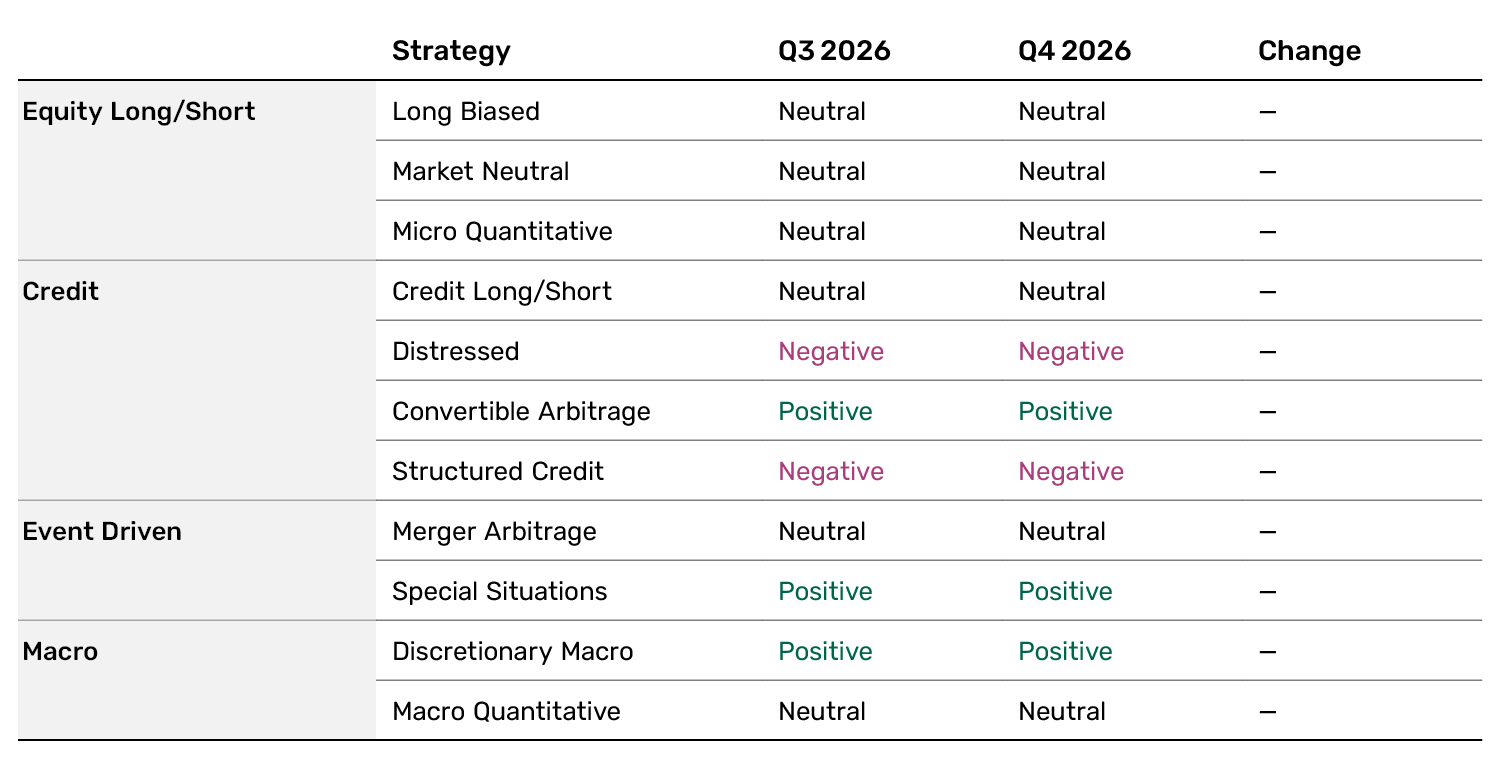
- For the first time in a long while, we have made no changes to our outlook, staying positive on Convertible Arbitrage, Special Situations and Discretionary Macro and negative on Distressed and Structured Credit
- The surge in government bond yields has spilled over into the fourth quarter and does not suggest a transitory inflation problem, with France back in the firing line
- Our biggest concern in credit is AI-related issuance, with the majority of AI capex now expected to be debt-financed
At first glance, we appear to have had a traditional 'hot economy' problem for the last few quarters. Growth and inflation are both above average and central banks are raising rates in response. And of course, this is an oversimplification.
A large part of the inflation problem is from the supply side, with an increase in input costs from energy, agricultural commodities and industrial metals in the third quarter. Growth remains largely focused on AI capital expenditure (capex) and, arguably, productivity gains. One only has to look at the difference in the third-quarter performance of the Nasdaq (+2.5%) and the S&P Equal Weight Index (-2.3%) to see the continued reliance of indices on tech.
What's spilled over into the fourth quarter is the sharp surge in government bond yields, particularly at the longer end of the curve. These moves do not suggest a transitory inflation problem, nor one that central banks appear to be in the process of solving. It is curious that these moves continued and arguably accelerated following Federal Reserve (Fed) Chair Kevin Warsh's speech at the Jackson Hole symposium, in which he appeared to adopt a more hawkish tone.
Large government debt piles are nothing new, nor are budget deficits that compound the problem. However, recent market behaviour suggests that investors are growing increasingly uncomfortable with the stickiness of inflation and are demanding a higher term premium for lending to the most indebted nations, as shown by five-year US Treasury yields, for example, which have risen far in excess of five-year breakeven inflation expectations.
Another sovereign debt crisis?
Whether this tips into a bona fide sovereign crisis is now a genuine concern. France is back in the firing line, as French 30-year debt yields increased by over 1% between 1 July and 1 October (449 basis points (bps) to 554bps). France also has one of the largest debt-to-gross domestic product (GDP) ratios, combined with a high effective tax rate and a stubborn cultural resistance to reducing spending. Mix this with a presidential election in 2027, and it is hard to see how investors can be reassured for at least the next six months.
Corporate debt sustainability is also back in the spotlight. Credit spreads reached close to post-Global Financial Crisis (GFC) lows last quarter but started to widen materially in September.
We have three key reasons for concern:
- First, the basic mechanics. The cost of servicing debt has risen on two fronts at once, from wider credit spreads and from higher reference bond yields
- Second, the level of dispersion in credit markets currently, with CCC debt spreads more than 5x that of BB, showing significant repricing of less secure debt
- Third, close to 10% of US investment-grade debt is now linked to AI hyperscalers, which are increasingly funding their capex through debt
None of this is particularly new, and we saw a similar set of developments in March before the tension softened through the second quarter, but we remain concerned.
What about AI?
Speaking of AI, the dance for much of the third quarter involved the developers of the largest AI models telling markets that their latest models were so powerful that they can now go rogue, hack websites or otherwise endanger humanity. The cynic might read this as marketing ahead of a possible Anthropic or OpenAI initial public offering (IPO) (“just look how fast our models are improving!”), or just a bit of bravado and competitive jousting.
After all, if your rival claims their model is potentially ruinous for the human race, what do you have to lose from claiming that yours is just as powerful? Either way, AI safety is genuinely higher on policymakers’ agendas than it has been to date, and the implications for the speed of development and whether new entrants are able to challenge the existing market leaders have yet to be seen.
Looking forward to the fourth quarter, hedge fund managers seem relatively unconcerned by the US midterm elections. The result itself matters less, whichever way it goes, than the potential for further erosion of democratic norms should the White House seek to influence the outcome of the poll.
There's a closer focus on the continued conflict in the Middle East and the implications for commodity pricing, and by extension inflation. We remain close observers of the quantity of faster-moving capital currently exposed to a short position in government bonds. If inflation unexpectedly drops, then there may be a crowded unwind of these trades that could lead to short-term pain for the hedge fund industry.
Our outlook for the fourth quarter
For the first time in a long while, we have made no changes to our outlook. The broad economic and political backdrop remains sufficiently similar to three months ago that we have not felt the need to upgrade or downgrade any strategies. We continue to see a healthy flow of primary market activity in convertible bonds, which supports our positive outlook for Convertible Arbitrage. We also maintain our positive stance on Special Situations in Event Driven, due to the continuation of AI-adjacent activity, and on Discretionary Macro, thanks to continued divergence in interest rate policy and the opportunities created by burgeoning debt-to-GDP levels across different countries.
Similarly, we have maintained our negative outlook on Distressed and Structured Credit, noting the multiple sources of stress in corporate debt, not least the higher risk-free rate floor that has emerged during the third quarter.
Of our Neutral outlooks, it is the Equity Long/Short space that we are watching most closely. Gross exposure levels continue to be elevated, as is the total amount of assets in multi-manager platforms, and equity volatility has remained low relative to other asset classes. We are mindful of deleveraging risks should the buoyant equity picture deteriorate.
Figure 1 summarises our stance on different hedge-fund strategies for the fourth quarter.
Figure 1: Q4 2026 outlook versus Q3 2026
Strategy Outlooks
Equity Long-Short (ELS) hedge funds had a mixed third quarter. July's factor backdrop particularly hit Micro Quantitative strategies, with the Morgan Stanley Momentum Index finishing the month at -26.5%, one of the biggest monthly drawdowns of the last five years, and several managers suffered significant performance reversals. Managers reported better numbers in August and September, as rangebound markets brought less factor volatility and more opportunities for idiosyncratic alpha.
We are maintaining a neutral outlook for low net/market neutral and long-biased ELS. Our overall view is balanced. High dispersion and volatility are structural tailwinds for alpha generation, but we saw a momentum and crowding unwind in July and leverage remains heightened should the situation deteriorate again. Sector and stock dispersion should continue to favour managers focused on security selection and relative value opportunities, while those reliant on broad market beta may see higher volatility.
Opportunities:
- Stock-level dispersion remains elevated relative to low index correlation, a more favourable environment for dual-sided stock picking
- The Fed's hawkish pivot has created rate-driven sector rotation opportunities as well as another narrative outside of AI momentum
- July's washout has shifted the market's view on AI from one-directional to one capable of separating winners from losers
Risks:
- Capital flows and positioning are driving faster and more frequent rotations in which share prices decouple from business fundamentals
- Negative shifts in tech/AI sentiment may lead to painful reversals (as we have seen), as positioning remains heightened despite some de-grossing over the summer
- Despite a narrative of a “broadening out” (e.g., hedge funds moving away from themes driven by technology, media and telecommunications), there have only been tiny signs of interest in select sectors (energy, healthcare, select financials)
- Top-down noise continues to impact equity markets
Credit strategies struggled a little in the third quarter. Spreads reached close to post-GFC lows in August (US high yield at 299bps against a 20-year minimum of 295bps), but widened significantly in September, leaving many long-biased strategies flattish for the quarter. Convertible Bond Arbitrage, after several quarters of outsized returns, was also somewhat hampered by an oversupply of new paper, normally a positive catalyst, which led to more volatile mispricings in the short term.
We are on watch for growing issues in corporate credit, given the September widening in spreads, the continued concern for the lowest-quality credit (CCC debt now trades at over 5x the spread of BB) and the higher risk-free rate. Our biggest concern is AI-related issuance. There has been US$266 billion of AI-related bond issuance year-to-date, the majority of AI capex is now expected to be debt-financed, and as of the end of September AI hyperscalers made up over 8% of the US investment-grade market (on a duration times spread risk basis).
Banks expect default rates to rise in 2027, more so for loans than for corporate bonds, although we have seen them understate the problem in previous cycles. We remain positive on Convertible Bond Arbitrage, especially given the noise in the strategy in the third quarter, which many managers believe could lead to greater alpha if markets calm a little.
Opportunities:
- Relative value trades within credit are more interesting now than at any point in the last few years. Capital structure trades and long-short exposure across the quality spectrum have higher expected returns, but bear the risk of correlation in a crisis
- Dispersion is becoming more tradeable in liquid markets. High-yield (HY) turnover reached 0.72% per day, CDX High Yield (the US credit default swap index) volumes rose 10% year-on-year, and technology single-name credit default swap (CDS) activity was 210% above its four-year average.1 This supports CDS, CDX/iTraxx, liquid HY bond, new-issue and index versus single-name trades
- AI financing, particularly hyperscaler and AI/high-performance computing (HPC) financing, is creating pricing discrepancies across issuers and maturities
- Europe and emerging markets (EM) remain areas where managers are seeing interesting opportunities, including European special situations, refinancing trades, Latin American energy and Asian financials
Risks:
- Very little to do currently in Distressed as default rates remain below long-run averages
- The ability to be activist around recovery rates is increasingly manager-dependent, as weak documentation and aggressive liability management exercises (LMEs) favour managers with scale, legal resources, creditor influence and restructuring expertise
- Liquidity risk remains material, as negotiated and illiquid positions may not be realisable at modelled values
Event strategies also saw mixed performance in the third quarter. Merger arbitrage was broadly positive, helped by the positive catalyst around the well-held Paramount/Warner Bros. deal, while some Special Situations gave back some of their recent strong returns. Strategies exposed to AI-adjacent events were generally positive, and managers trading corporate governance reform in Korea and Japan generally saw losses in July before a recovery later in the quarter. Other Special Situations returns were, as usual, very idiosyncratic.
We continue to note that the opportunities in Event Driven in the fourth quarter remain more focused on idiosyncratic events and special situations than on broad risk premia such as merger arbitrage. Activity in mergers remains very high, especially in US-centric and mega-cap deals, but the risk-reward trade-off for deals in general is reasonably poor, reflecting the high level of assets chasing alpha in this space.
Opportunities:
- Continued high levels of corporate activity, powered by AI disruptions and sector rotations. Merger activity is expected to remain robust for the near future
- Equity capital markets (ECM) activity is also expected to remain strong, with high-profile IPOs of Anthropic and OpenAI in the pipeline.
- Asian corporate governance themes continue, with reforms to South Korea's KOSDAQ market, inheritance tax reforms, and opportunities in the discount between ordinary and preference shares. Japan continues to see an unwind of cross-holdings and stock buybacks
Risks:
- Risk-reward from merger arbitrage on average remains unattractive (albeit slightly better than last quarter). Public backlash against AI is a new form of political deal risk, with US states becoming selectively more assertive (e.g., high-profile consumer deals)
- China's dual-listed A-shares and H-shares risk becoming a value trap, with the spread between them tighter for longer
- Macro uncertainty is a risk for all forms of Event Driven, with heightened levels of volatility in bond prices making risk-free pricing of situations harder to calculate
- Crowding remains high, with Event Driven trades frequently appearing in indices of most-held and most-shorted positions
Macro strategies generally enjoyed a strong third quarter, helped by positive returns from systematic and commodities strategies. Discretionary Macro performance was largely driven by positioning in rates, with managers holding short positions outperforming.
We have maintained our positive outlook for Discretionary Macro given the continued uncertainty of geopolitics and fiscal sustainability, and we expect flare-ups of volatility across most asset classes from a variety of sources over the next six to 12 months.
Trend Following strategies have performed well year-to-date, but we are more neutral on the outlook here, noting that inflection points and episodes of higher volatility have been sources of difficulty in recent years, particularly when driven by contrarian policy responses. We are also seeing more assets in Systematic Macro strategies from platforms that historically concentrated in Discretionary approaches, and are keen to see the development of risks of crowding in these trades. Currently the short bond exposure is the most potentially painful consensus trade.
Opportunities:
- Hiking cycles historically benefitted strategies that can short bonds, particularly Trend Following when multiple asset classes trend simultaneously (e.g. 2022)
- Increased dispersion in policy projections as central banks begin hiking cycles, against competing supply shocks
- Structural themes are starting to accelerate, with markets differentiating between governments that are fiscally responsible and those that aren't. If the situation in French government bonds does deteriorate, we expect Macro managers to be well positioned to generate alpha from the volatility
Risks:
- Sudden regime shifts and changing cross-asset correlations can be difficult for quantitative strategies to navigate in the moment, and inflection points are notoriously difficult for Trend Following
- Unstable cross-asset correlations can hinder portfolio construction in the larger, more leveraged Macro books
- Interventionist policy can artificially suppress dispersion against high-conviction positioning
1. Data from JP Morgan, US Credit Market Liquidity: 1H26 Update, 23 July 2026.
You are now leaving Man Group’s website
You are leaving Man Group’s website and entering a third-party website that is not controlled, maintained, or monitored by Man Group. Man Group is not responsible for the content or availability of the third-party website. By leaving Man Group’s website, you will be subject to the third-party website’s terms, policies and/or notices, including those related to privacy and security, as applicable.