Key takeaways:
- The world continues to be marked by elevated uncertainty across geopolitics, monetary policy and technological disruption, driving significant volatility at both the asset class and security level
- Against this backdrop, we have downgraded three strategies: Long-Biased Equity Long/Short to neutral, Merger Arbitrage to neutral on tighter spreads, and Structured Credit to negative given weakness in Private Credit and the risk of contagion
- Geopolitical and AI themes increase the risk of market shocks and rotations in market leadership, an environment that we believe favours active strategies
1. Introduction
Last quarter we noted that “few observers can be left in any doubt that we are now in an era where unilateral military strength outweighs the value of treaties and the international rule of law. Such a backdrop inevitably deemphasises the role of structures such as the United Nations and NATO and raises questions around the shape of the future world order”. At the time, we were referring to the US seizure of former President Nicolas Maduro in Venezuela, but the sentiment bears repeating and is reinforced by the actions of the US and Israel in Iran during March.
The heightened level of volatility across all asset classes has posed questions to many hedge fund strategies in the first quarter. Most notably, the restrictions on the free movement of commodities, particularly oil and gas, quickly revived the spectre of inflation. As we have noted several times since the COVID crisis, the global economy is now facing multiple inflationary pressures, which are more easily reignited during any restrictions on global trade.
It seems reasonable to assume that we are now firmly in an era of uncertainty and instability in geopolitics, which can feed through to market volatility with relatively little warning. The Middle East is arguably less secure than it was before the US strikes on Iran, and other countries are likely to be emboldened to further their own territorial ambitions given the impunity with which the US has acted this year.
The second theme which has remained pertinent over the last few quarters is AI. We continue to believe that AI will be disruptive to other industries, much as we have seen in the first quarter with SaaS (software as a service) names. We also expect AI itself to be a source of market volatility due to the propensity for exuberance and fear associated with the difficulty in pricing companies in this ecosystem. One must only look at the breadth of opinions on, say, the correct price for an OpenAI IPO to recognise that there will be some investors who will be very wrong in their read on the market implications for AI productivity and profitability. There have been some initial concerns around private credit exposure to software in the first quarter, but we will be watching for further weaknesses from all areas of technology as we move through the remainder of this year. Any perceived failure of the AI ecosystem around data centres (and AI’s ability to generate sufficient profits to justify the enormous levels of capital expenditure [capex]) could lead to a snowballing of private credit troubles.
Beyond the more immediate impacts from AI (both as a disruptor itself and on the companies it is disrupting), there are longer-term themes related to technological developments that we are watching. How AI changes the broader make-up and level of employment across the developed world feels like a key theme for the next five to 10 years. What will employment look like when software and hardware can replace much of the value added by humans in the current economy? How will governments react through both regulation and policy to protect social cohesion? Will companies see a quantum leap in productivity as an opportunity to slash staff numbers, reduce the price of their products (and thereby make AI a deflationary impetus), or accelerate the growth of their business into new areas?
Both the geopolitical and AI themes increase the risk of market shocks and rotations in market leadership. We continue to believe that active strategies are best placed to navigate a changing world, whereas passive exposures may be late to react to new paradigms.
2. Our Outlook
Hedge fund performance remained broadly positive in Q1 2026, though pockets of difficulty arose from heightened geopolitical tensions, notably the Iran conflict, and the continued repricing of AI-related assets. Trend Following strategies again faced challenges around exogenous market shocks in March, highlighting the vulnerability of systematic approaches to sudden regime shifts, but performance over the quarter, and the speed of repositioning in March suggest that the strategy has adapted well to a more uncertain policy landscape.
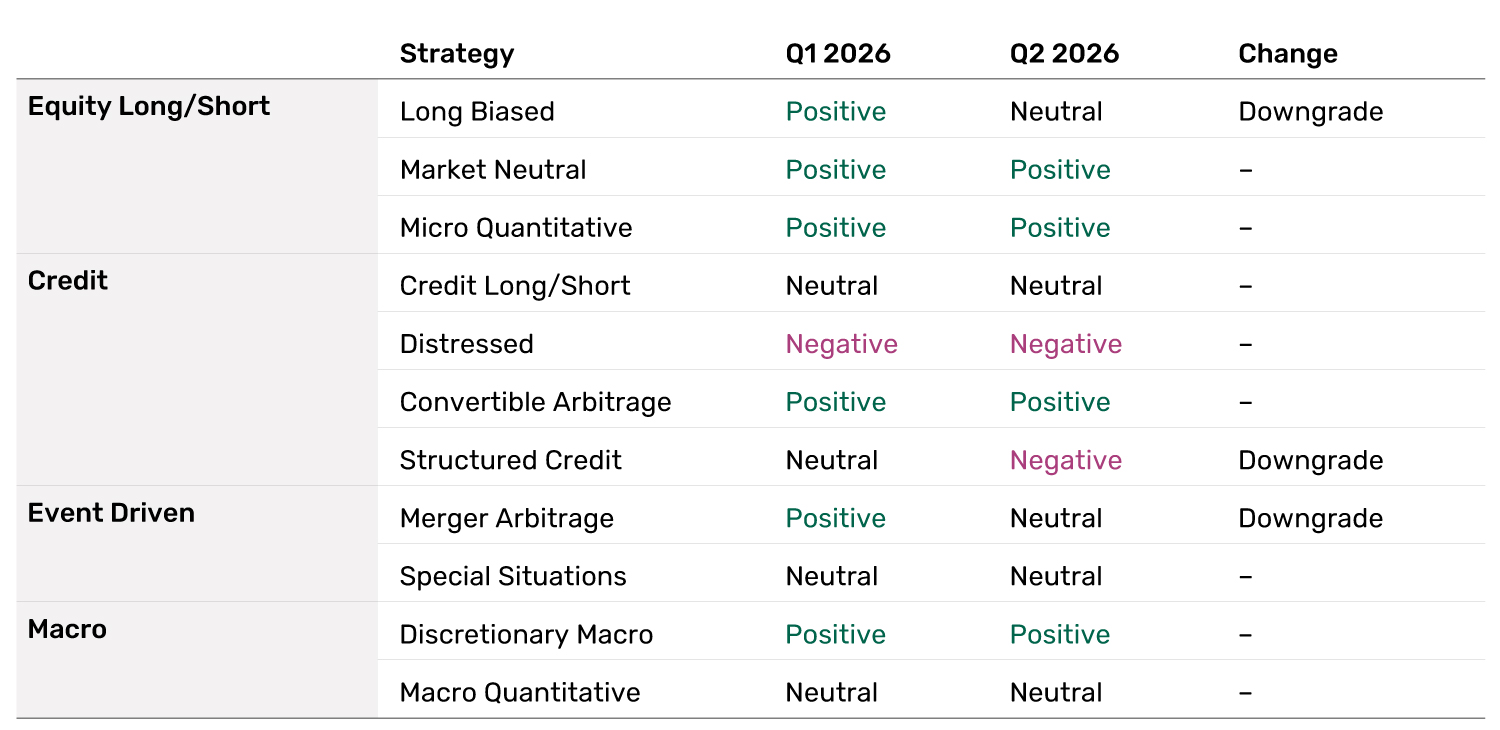
We expect the environment for alpha generation to remain broadly supportive heading into the second quarter. The world continues to be marked by elevated uncertainty across geopolitics, monetary policy and technological disruption, driving significant volatility at both the asset class and security level. We have, however, made several downgrades to our outlook this quarter: we have downgraded Long-Biased Equity Long/Short to neutral (while maintaining our positive view on low net/market neutral), downgraded Merger Arbitrage to neutral on tighter spreads, and downgraded Structured Credit to negative given the weakness in Private Credit and the risk of contagion.
Figure 1 summarises our stance on different hedge-fund strategies for Q2 2026.
Figure 1. Q2 2026 Outlook versus Q1 2026 Outlook
3. The Details
3.1 Equity Long/Short
We maintain a positive outlook for low net/market neutral Equity Long/Short strategies while downgrading long-biased Equity Long/Short to neutral. We believe that active management remains best placed to navigate a market characterised by AI-driven and geopolitical disruptions, and the backdrop for alpha generation over beta-driven returns remains favourable.
We remain positive on micro quantitative equity strategies but risks mean we should expect more day-to-day volatility and potentially lower Sharpe ratios, making conviction in holdings even more important. Managers are running at higher gross market value to generate attractive returns for investors, which can lead to crowding. Dispersion remains healthy in the US and is improving in other regions, with improving breadth.
Opportunities:
- Global equities continue to be marked by higher dispersion, sector rotations, and lower correlations – even though index volatility has not yet spiked meaningfully. Market leadership has expanded beyond select mega-caps
- Heightened earnings uncertainty creates gaps between share prices and fundamentals, which is a potential alpha opportunity
- We believe the consumer sector remains rich for stock-picking due to a growing gap between high- and low-income consumers
- The geopolitical backdrop has created new winners and losers, even if short-term in nature
Risks:
- Perceived AI disruption risk can lead to significant volatility in specific industries/sectors (e.g., Software, Financials)
- Medium-term momentum is both crowded and has been a significant contributor to fundamental Equity Long/Short alpha returns year to date; any sustained reversal could challenge performance
- There are trickle-down effects from a sustained oil shock (inflation, growth, rates) which may be difficult to navigate and cause short-term volatility
- Increased concentration in crowded names and/or themes may intensify the severity of reversals
3.2 Credit
We remain positive on Convertible Arbitrage, neutral on Credit Long/Short, negative on Distressed, and are downgrading Structured Credit to negative.
We have maintained our positive view on Convertible Arbitrage. Record issuance in 2025 (US$166 billion at 2x average) was followed by a strong start to 2026 (US$38 billion in January to February), though March slowed to just US$2 billion. 2025 issuance was well-diversified across sectors, though the share of AI-adjacent issuance increased in the fourth quarter. A large volume of convertible bond and high yield maturities over the next several years should sustain supply, with approximately US$180 billion in maturities set to be refinanced through 2026 and 2027. Higher-for-longer rates make convertible bonds attractive due to lower coupons, and Convertible Bond Arbitrage benefits from elevated single stock realised volatility. M&A tailwinds also help, with bonds redeemed early or converted at higher ratios.
We remain neutral on Credit Long/Short and need to be selective in picking managers who can navigate this market. After a long period where avoiding losers was not necessary, we may be entering an environment where it will be. Credit spreads are tight but beneath the surface, we see signs of rising dispersion. Shorting individual names in credit remains challenging due to limited liquidity, restricting the toolkit to index hedges, particularly for larger managers. Multi-strat credit players are increasingly active in less liquid credit markets (privates, structured credit, SRTs), suggesting the opportunity set is less attractive in liquid credit.
We remain negative on Distressed, but we believe the ingredients are coming together for a distressed cycle. Years of largely good or easy conditions have created the set-up for bad businesses to exist and bad lending to take place. Payment-in-kind has increased five times since 2021 in business development companies (BDC), there is a divergence in public versus private credit proxies, and activity in liability management exercises (LMEs) has increased significantly – all signals of defaults being delayed but not avoided. Our view would turn more constructive on signs of a macro shock triggering a default cycle, private credit liquidity issues, LME fatigue, or PIK-to-default conversion accelerating.
We have downgraded Structured Credit to negative. Despite recent widening, spreads sit near the tightest levels in the past five years, leaving little margin for error should fundamentals deteriorate. Loss-adjusted yields are still at moderately attractive levels but are expected to trend lower with further rate cuts. Managers are running extremely defensive portfolios with plenty of cash on hand and higher levels of tail risk hedging.
Opportunities:
- Sustained supply from record convertible bond issuance and a large maturity wall supporting the convertible arbitrage opportunity set. Single stock realised volatility is likely to remain elevated, driving gamma trading profits
- Rising levels of dispersion are expected to be positive for Credit Long-Short strategies
- AI infrastructure demand has spurred growth in datacentre asset-backed securities (ABS) and commercial mortgage-backed securities (CMBS), primarily in the US. Unlike traditional commercial real estate, data centres benefit from long-term leases and high-credit tenants. We believe the recent selloff could present an attractive entry price
Risks:
- The overriding risk in Credit strategies currently is the global tightness of spreads. Valuations are frothy and sensitive to rising rates
- Potential for credit quality/spread widening concerns: ballooning capex and high-growth tech, as well as crypto. As convertible bonds become more corporate bond-like, more hedging is needed
- Collateralised loan obligation (CLO) portfolios have high exposure to Software and Business Services sectors (approximately 10% in Europe, higher in the US) with a significant maturity wall coming in 2028. Pressures in a looser private credit market may force distressed asset sales
3.3 Event Driven
We have downgraded our outlook for Merger Arbitrage to neutral and maintained our position on Special Situations at neutral. Headwinds and uncertainties are rising: year to date, M&A activity is decent but the current roster of 2026 deals is “safe and tight”, while deals with wider spreads are typically looking to close in 2027. Software deals carry higher risk of extension and/or failure, and new tariff uncertainty adds to the risk.
Opportunities:
- The structural upswing remains very plausible – spreads are widening especially on longer-dated deals, the Trump “window” for aggressive deals remains open, and the US and UK antitrust environment is permissive
- Japan’s M&A story continues to strengthen with increased activity, competitive bids and foreign buyers. The majority of transactions are strategic deals paying a premium, and a significant uptick in spin-offs is forecast for 2026
- Cross-border shareholder activism in Japan is growing. In Korea, ongoing corporate reforms remain attractive, including dividend tax separation, treasury share cancellation, and mandatory Value-Up disclosures. Idiosyncratic legal special situations remain attractive
Risks:
- Potential for a deep energy and sentiment shock to the economy due to the Iran conflict, with the potential for risk-off/recession and higher rates, especially in Europe. Asian markets are very energy sensitive
- Private equity bids are likely to be lower, and financing markets, while open, could become restrictive. We see less upside potential of competitive bids when a weaker stock market curbs appetite to pay premiums
- Korea market intervention risk, e.g. short-selling bans or new political developments
3.4 Macro
We maintain our positive view on Global Macro strategies. Market developments in March may have opened attractive entry points for existing themes, while disparate policy responses and renewed policy error risks have the potential to stoke new opportunities. We think Emerging Market Macro strategies can also benefit from recent disruption and upcoming elections in key jurisdictions.
In Quantitative Macro, we note that Trend has recovered considerably over the last six months but remains somewhat vulnerable to exogenous market shocks. We expect Trend’s more defensive positioning as we move into the second quarter to be beneficial from a portfolio perspective. Niche areas in Macro, such as Quant Commodities or Digital Assets plays, remain attractive, in our view.
Opportunities:
- We remain in a macro-driven environment which should be a positive backdrop for Macro strategies. Discretionary Macro can generate alpha from divergent economic performance and policy responses
- We remain positive on Fixed Income Relative Value funds as the regional opportunity set broadens out and evolving issuance and purchasing dynamics create opportunities
- We are excited about the longer-term opportunity set for Commodity strategies, with a significant amount of domain knowledge moving from physical merchants to the buy-side
Risks:
- The Quantitative Macro space remains in a state of flux. Strategies may take time to adjust to the new market regime, in particular, unique events arising from geopolitics can sometimes be harder to trade for models trained to spot patterns in previous data
- Discretionary Macro approaches can sometimes behave best in a period when traditional risk assets are falling. If we see a continuation of the equity rally, Macro managers face the choice of cutting risk or aligning with traditional risk factors and sacrificing diversifying characteristics
You are now leaving Man Group’s website
You are leaving Man Group’s website and entering a third-party website that is not controlled, maintained, or monitored by Man Group. Man Group is not responsible for the content or availability of the third-party website. By leaving Man Group’s website, you will be subject to the third-party website’s terms, policies and/or notices, including those related to privacy and security, as applicable.