Key takeaways:
- Iran and AI dominated the first half of the year and we believe they look set to define the third quarter too, with the war beginning to rattle oil markets again and equity market leadership increasingly focused on perceived AI winners
- Against this backdrop, we have downgraded both qualitative and quantitative Equity Market Neutral as we expect traditional equity market alpha to be harder to generate in this volatile landscape. Crowding also remains a risk
- We are positive on areas that can generate alpha from AI-adjacent corporate activity, and have upgraded Event Driven Special Situations to positive and maintained our positive view on Convertible Arbitrage
Note for our readers; Early View has had a facelift. We have merged it with our Hedge Fund Strategy Outlook, which means you now get our market insights, strategy reviews and our key calls for the three months ahead in a single quarterly read.
In the first half of the year, Iran and AI dominated the market narrative, and the third quarter looks likely to be much of the same.
On Iran, the calm has broken. For much of the second quarter the market appeared to treat the crisis as largely solved, with the conflict rumbling on, oil not yet flowing through the Strait of Hormuz at anything like previous levels, and front-month contracts drifting below where they were before it started.
However, at the time of writing, the war appears to have restarted in earnest, re-closing the Strait and rattling oil markets, with an uncertain path from here. Oil stockpiles are lower than they were in February, but markets are wary to price in too much fear too soon. Inflation expectations and the oil price have risen but appear mindful that under the current US administration, rapid de-escalation is as likely as rapid escalation.
AI boom and bust mini-cycles
On AI, the second quarter was a full-throttle return to the bull thesis after a couple of quarters of stuttering, and anything touching the story posted stellar returns. Korea’s KOSPI, dominated by Samsung and SK Hynix, was up a staggering 68%, and beneath the surface, beta, momentum and growth led while quality and value were left behind.
That is the signature of narrowing leadership rather than a broad advance, capped by the SpaceX listing (the largest IPO in history, creating the world’s first trillionaire) and with Anthropic and possibly OpenAI IPOs still to come in the second half of the year. We continue to believe AI will likely be a source of volatility, given the propensity for exuberance and fear that comes with the difficulty of pricing this ecosystem.
We expect to see mini-cycles of boom and bust within different areas of the AI theme, with credit and capital expenditure (capex) flows moving more or less aggressively into (in no particular order) semiconductors, particularly new entrants to this space; data centre buildout ‘picks and shovels’; hyperscalers; and end-user AI functionality.
It’s getting crowded for hedge funds
For hedge fund managers, this is an environment riven with both opportunities and risks. The narrowness of the market narrative risks driving further crowding into the trades that have worked so far, as the momentum factor shows.
But it is a double-edged sword, and hedge funds are also over-represented on the short side of the expensive AI names. The Goldman Sachs Most Shorted Index returned 35.4% in the quarter, well ahead of the broader market and a painful result for anyone short those names.
Most managers, though, carry some exposure to the momentum factor, either deliberately in the case of trend followers or simply by letting their winners ride and cutting their losers.
Either way, the industry had a strong second quarter, with the HFRX Global Hedge Fund Index up 5.4% and the Equity Hedge Index up 10.3%. The concern is what comes with it. Gross and net exposure are running high again, which leaves the industry looking overextended should we hit a period of consolidation.
Outlook change
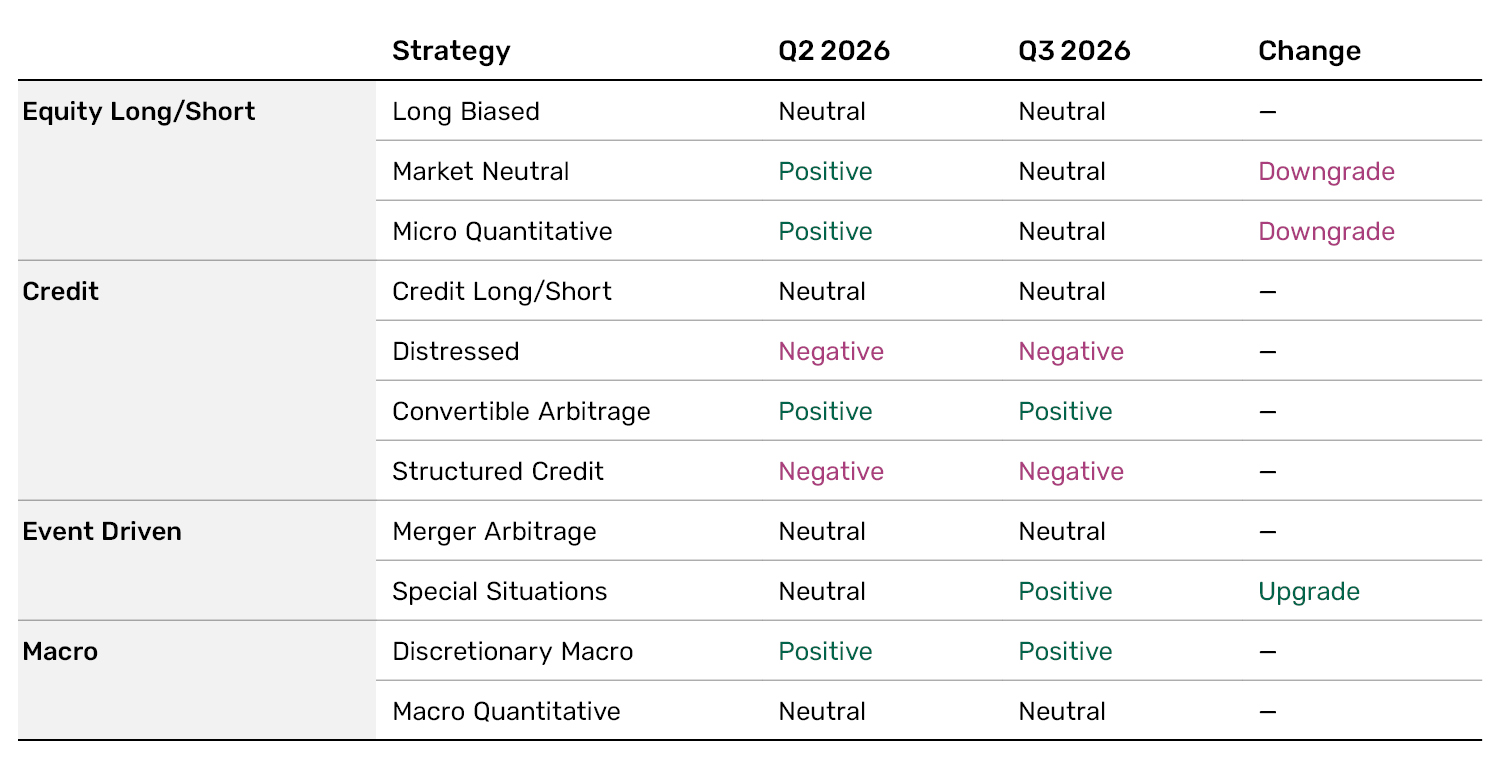
We expect the third quarter to remain highly idiosyncratic, with geopolitical uncertainty and AI likely continuing to set the tone. That view has moved our ratings. We have downgraded our outlook for Equity Market Neutral, both qualitative and quantitative, as the evidence mounts that managers have struggled with crowded trades and a volatile factor landscape.
We have upgraded Event Driven Special Situations, where managers have been best placed to turn idiosyncratic corporate activity, not least the wave of large IPOs, to their advantage. As ever, we continue to believe active strategies are best placed to navigate a shifting world, where passive exposures risk being late to react.
Figure 1 summarises our stance on different hedge-fund strategies for the third quarter.
Figure 1: Q3 2026 outlook versus Q2 2026
Strategy outlooks
Equity Long/Short managers had a mixed second quarter. Headline indices flattered the picture, but much of that came from beta to the wider market, or from concentrated bets on strongly performing sectors, factors and themes. Market neutral strategies generally struggled, the more quantitative ones most of all, where rising factor volatility scattered returns and left some managers with a notably weak May.
That split is why, in the most notable ratings change in this report, we have downgraded low net/market neutral Equity Long/Short to neutral, alongside Micro-Quantitative, while Long-Biased strategies stay neutral.
Gross leverage has continued to run very high, net leverage has rebounded, and risk looks increasingly concentrated at the factor and thematic level, with the macro backdrop and stretched earnings expectations pointing to more volatility and dispersion within equity indices.
We believe risk models are increasingly being tested in their ability to measure true diversification, even as quantitative and 'quantamental' Equity Long/Short has remained a popular target for allocator flows.
Opportunities:
- Dispersion has remained elevated, and a positive, if occasionally frustrating, signal has been the decoupling of the AI trade into distinct sub-components, such as power, compute and applications
- The emergence of a K-shaped economy in both the US and Europe is a tailwind for stock picking within consumer sectors
- Geopolitical de-escalation, if it materialises, may ease macro concerns and offer catch-up opportunities in cyclical sectors
- In quantitative strategies, speed has continued to matter, with faster strategies showing signs of adapting better to current conditions
Risks:
- Flows and capacity present a multi-part risk. Significant capital sits in multi-manager structures with overlapping exposures, where de-grossing events can have an outsized impact; allocator demand for quant equity is itself a risk; and proprietary trading firms add to competitive and capacity pressures
- Crowding and increased concentration in popular names may intensify the severity of reversals, an effect that appears most acute in short positions and in certain factors
- Emergent factors, such as the data centre buildout materials sub-set of the AI theme, have led some managers to hold concentrated bets that existing risk models struggle to identify or measure
- A negative shift in the tech/AI trend could prove disruptive, with positioning in momentum, beta, semiconductors, tech hardware and short software near recent highs, alongside elevated exposure to Korea and Taiwan. Retail crowding in these themes has only added to the risk of a reversal
- New Federal Reserve (Fed) Chair Kevin Warsh has struck a more hawkish initial tone on monetary policy, and higher-for-longer rates may compress multiples for already richly valued, crowded AI and growth stocks
Credit strategies benefitted from tightening spreads last quarter, with high yield close to its tightest levels since 2008. Net long managers made money, but there was little alpha across Credit Long-Short beyond market risk. Convertible Arbitrage fared better, helped by the same credit tailwind and by good alpha from heavy primary activity, much of it AI-linked, and from gamma trading in high-volatility single names.
Underneath the surface, high-yield index spreads look deceptively calm. Rising inflation expectations and the prospect of further rate hikes lend a more cautious undertone. Further, private credit non-accruals are running well above official default rates pointing to a larger shadow pipeline of stress than the headlines suggest, concentrated in software, with forecasts pointing to a sharp step-up in defaults from 2027.
The market is increasingly tiering risk by fundamental quality rather than liquidity alone, fertile ground for fundamental credit selection even with index spreads tight. According to the key Bank of America credit indices, CCC spreads have widened about 95 basis points (bps) year-to-date while BB have tightened 13bps, taking the CCC/BB ratio close to an all-time high of nearly 4.5x.
The distressed set is now defined by negotiated, legal and structural stress rather than binary defaults, with distressed exchanges the norm. The effective default rate nearly doubles once liability management exercises (LMEs) are included, a record share of defaults are repeat defaulters, and industry estimates suggest most LMEs fail again within three years, creating a permanent, recurring pipeline of distressed opportunities. With a substantial maturity wall approaching in 2027 and 2028, that pipeline points to a further public default wave ahead.
Structured Credit spreads remain compressed, leaving little margin for error and a less attractive reward-risk profile, and managers are running strategies defensively with elevated cash and more tail-risk hedging. Our one area of continued optimism is Convertible Arbitrage, where we note that 2026 issuance has continued to break records at roughly 2.5x the average pace, and a large volume of convertible and high-yield maturities in the coming years should sustain supply.
Opportunities:
- For Convertible Arbitrage, single-stock realised volatility is likely to remain elevated, which should benefit gamma trading profit and loss (P&L) given its nature as a long-volatility strategy. Alpha has continued to be available from corporate events such as buybacks, exchanges and secondaries
- Elsewhere in credit, rating decompression and bifurcation are increasing dispersion by sector, size, capital structure, risk factor and idiosyncratic catalysts. The gap between the best- and worst-performing high-yield sectors reached 288bps in a single month, with idiosyncratic price moves increasingly common
- AI disruption is concentrated in specific pockets, such as software within direct lending, creating further dispersion potential
- Refinancing migration, with a meaningful share of private credit refinanced into the public syndicated loan market in 2025, is bringing formerly opaque, illiquid risk into the tradeable public arena
- Declining collateralised loan obligation (CLO) formation is removing a key technical demand driver for loans, which could widen spreads on lower-quality tranches, while a substantial share of the loan market trading at or above par creates negative convexity dynamics worth positioning around. In the US, AI infrastructure demand has spurred growth in data centre-linked asset-backed securities (ABS) and commercial mortgage-backed securities (CMBS), which benefit from long-term leases and high-credit tenants relative to traditional commercial real estate
- In Europe, regulatory changes and shifting spending priorities across defence, technology and energy security are creating new funding needs, setting the stage for an uptick in asset-backed issuance
Risks:
- Contagion from private credit weakness has remained the biggest systemic risk for the asset class
- Continued LME extensions remain a persistent feature of the market
- A substantial ‘wall of cash’ in direct lending looking for deployment could compress the opportunity set
- Hidden AI concentration risk may erode the diversification benefit that structured credit has historically offered
- Spread compression and relative loan price stability have reduced CLO equity returns
Returns to Event-Driven strategies were broadly positive in the second quarter but were very theme- and strategy-dependent. Broader strategies such as Merger Arbitrage were muted despite decent deal activity, while more idiosyncratic strategies continued to perform well.
Themes such as AI winners versus losers, ECM, legal events and Asian corporate governance reforms all worked during the quarter, and those trades appear to have driven gains across broader swathes of the industry, particularly the narrower, thematic parts of the Equity Long-Short universe.
Looking ahead, we note that boards and corporates continue to adapt to persistent uncertainty. Mergers and acquisitions (M&A) activity in the US remains very high, especially among large caps and minority buyouts, and cross-border activity has picked up.
Europe was slower but improved in the second quarter, again in large caps. Japan has continued to show high outstanding deal volumes despite a slower quarter and tighter spreads, and there is a notable pipeline of pre-announced deals under discussion in the UK. Outside Merger Arbitrage, the opportunity set is very idiosyncratic, with corporate event activity supported by AI disruption and sector rotation into defence, cybersecurity, energy infrastructure, logistics and hard commodities. Across these disparate themes managers are finding multiple ways to generate alpha, not least from corporate actions tied to AI, such as high-profile IPOs, and we have therefore raised our outlook for Special Situations managers to positive.
Opportunities:
- Relative value trades, such as holding company discounts, share class arbitrage, China A/H (mainland-listed A-shares against Hong Kong-listed H-shares) and American depositary receipts (ADRs), have continued to benefit from volatility and market inefficiency between domestic and foreign sentiment and liquidity
- Equity capital markets issuance is increasing, particularly in large-cap AI names and in Asia-Pacific (APAC), with a wave of Chinese A-share firms announcing H-share issuance
- Credit issuance has remained ample, though often priced too tight, while wider credit dispersion or distress would be a tailwind for relative value mispricings
- Special purpose acquisition companies (SPACs) are recovering after several well-received deals, and IPO activity is up
- Upcoming reforms in Korea, ongoing buybacks and crossholding unwinds in Japan, and legal special situations tied to AI litigation, monopoly cases and regulatory shifts in AI and energy all add to the opportunity set
- Fewer M&A deal breaks and fewer regulatory second requests are supporting a constructive backdrop for Merger Arbitrage
- Activism levels remain high, offering additional upside potential alongside moderate headwinds
Risks:
- Macro and geopolitical fragility, including energy-related shocks to the global economy, inflation and rate hikes, remain key risks
- Policy uncertainty around tariffs, crowding that compresses spreads and amplifies drawdowns, and a thinner deal pipeline could all weigh on returns
- Merger spreads remain around their historical average of 4-6% annualised, but the distribution is barbell-shaped: safe deals trade tight while only the highest-risk deals trade wide, limiting the overall opportunity set
- Public backlash against AI represents a new form of political risk, and so-called 'acquihire' deal structures, which are primarily designed to secure talent rather than product or IP, may divert flow away from traditional public spread opportunities
Macro strategies had a mixed second quarter, with both systematic and discretionary approaches whipsawed by the sharp resolution of hostilities early in the quarter, though commodity trading advisers (CTAs) quickly repositioned for the relief rally and generally finished in positive territory.
Managers across the board struggled to find consistent themes in government bonds, where yields rose across the curve through the first half before falling back, along with inflation expectations, in the second. The same difficulty applied to reading central banks, with expectations around hawkishness and dovishness oscillating through the quarter.
We are maintaining our positive stance on Discretionary Macro, though we note that the main challenge remains sourcing sufficient capacity for the most attractive trades. We are particularly interested in commodity strategies, which have delivered mostly positive returns year-to-date and have continued to see strong launch activity, with a significant number of new commodity hedge funds started in 2025 and 2026. Outside of commodities we continue to favour emerging markets strategies, though we again note the challenge of capacity here.
In Systematic Macro, the strong run of returns since 'Liberation Day' has continued, and systematic futures strategies are seeing growing interest from multi-strategy platforms. We maintain our neutral outlook here, primarily on the flow of assets in recent years and our continuing concern that market choppiness is increasingly driven by political interventions, which are themselves prone to reversal.
Opportunities:
- Volatility and dispersion in policy expectations, together with the ongoing potential for policy errors, continue to create fertile ground for macro traders
- Macro strategies have historically performed well during hiking cycles, a dynamic that remains relevant to the current environment
- Tensions in the Middle East carry the potential for lasting impacts on commodity markets, while developing El Niño conditions could stoke further volatility and dislocations in agricultural markets
- Model enhancements continue, with faster models and more 'localised' strategies increasingly a feature of quant macro programmes, and growth in assets under management (AUM) via platform allocations is likely to accelerate and prolong this trend
Risks:
- Disappointing first-half returns in Developed Market Discretionary Macro could push managers towards more muted risk-taking in the second half of the year
- The narrowness of the market narrative has left managers continuing to report difficulty finding genuinely idiosyncratic themes, particularly within emerging markets
The flipside of growing platform interest in Systematic Macro is capacity constraints and increased competition for alpha across the peer group
You are now leaving Man Group’s website
You are leaving Man Group’s website and entering a third-party website that is not controlled, maintained, or monitored by Man Group. Man Group is not responsible for the content or availability of the third-party website. By leaving Man Group’s website, you will be subject to the third-party website’s terms, policies and/or notices, including those related to privacy and security, as applicable.