Key takeaways:
- GLP-1 receptor agonists (GLP-1s) could mark the next structural shift in population health thanks to their potential to transform the treatment of diabetes, obesity and a range of associated chronic diseases
- An unanswered question is whether GLP-1s will extend healthspan, lifespan or both: will people live more years in good health, or will longer lives also mean more years managing illness?
- GLP-1s may reshape the healthcare cost curve rather than simply lower it. Preventing costly health complications is only part of the equation. Ongoing treatment costs and the financial consequences of a longer-lived population also matter
Introduction
The quest for immortality has long been an obsession, and human lifespan has significantly increased across the world in the modern era, although geographical disparities remain. Advances in nutrition, sanitation, economic growth and poverty reduction, as well as medical interventions, primarily through antibiotics and vaccines, have all contributed.
More recently, a class of drugs called ‘glucagon-like peptide 1 (GLP-1) receptor agonists’ (originally developed in the 1980s as a treatment for type 2 diabetes) have shown significant potential beyond their initial approved use. These “weight-loss drugs” are increasingly seen as potentially improving healthspan and extending lifespan by addressing several chronic diseases at once.
However, if the clinical benefits of GLP-1 drugs do translate into sustained improvements in population mortality, the consequences could extend beyond healthcare. Longer lives could create a liability shock for medical economics, state pension systems and the living benefit business of life insurance. These potential effects are not yet well understood or modelled and appear to have caught many industries, and the actuaries they rely on, by surprise. Actuarial models are built on historical mortality data, but these drugs may represent a genuine structural shift in population health with limited historical precedent.
In this paper, we explore the evidence for such a shift, the uncertainties surrounding it, and the potential implications for healthcare financing, pensions and insurance.
The obesity epidemic and GLP-1 therapies
In 2021, more than 2.1 billion adults globally were classed as overweight or living with obesity, a figure that is projected to reach almost 3.8 billion by 2050, more than half of the world’s adult population.1 Strongly associated with type 2 diabetes, cardiovascular disease and several cancers, obesity was attributed to an estimated 3.7 million deaths globally in 2021.2 By 2035, obesity-associated economic costs are estimated at up to US$1.6 trillion annually in upper middle-income countries; and obesity could reduce global GDP by an estimated 2.9%, equivalent to ~US$4 trillion.3
Against this backdrop, GLP-1-based therapies have emerged as an important treatment option. The hormone GLP-1 is released after eating and helps regulate blood sugar and energy intake. It was discovered in the early 1980s, paving the way for the development of GLP-1 receptor agonists to treat type 2 diabetes. In practical terms, GLP-1 drugs reduce appetite, improve glucose control and as a result drive substantial weight loss.
The GLP-1 receptor agonist category has evolved rapidly. Semaglutide, marketed as Ozempic for diabetes and Wegovy for obesity, primarily targets the GLP-1 pathway alone. Newer drugs, including tirzepatide (Mounjaro/Zepbound), combine multiple metabolic hormone pathways to produce greater weight loss and broader metabolic effects. Beyond weight loss, large clinical trials have reported benefits across several obesity-associated conditions, including cardiovascular and kidney diseases.4
These findings raise the possibility that such therapies could alter the course of several major chronic conditions at once. Whether those benefits will translate into substantial improvements in population life and/or health expectancy remains an open question.
Impacts on healthcare systems
The intuitive health-economics story is that by reducing expensive healthcare events, GLP-1s will save money. However, the picture is far more complex in that GLP-1s may reshape the cost curve rather than simply lowering it.
Preventing or deferring cardiovascular and renal events shifts spending away from acute, episodic, high-intensity care and toward continuous pharmaceutical spend on chronic conditions. In effect, health systems trade a lumpy, back-loaded cost for a smooth, front-loaded cost that may be much larger in aggregate because it is applied across a far bigger treated population. Whether this produces net savings depends heavily on drug price and on user adherence.
This produces a prevention paradox for payers. Because a disproportionate share of lifetime healthcare costs is concentrated in the final years of life, deferring death does not necessarily eliminate end-of-life spending. Rather, it shifts some costs later and typically adds the intervening years of drug cost on top. The balance depends on how far treatment reduces illness during those additional years: better health and longer lives need not necessarily translate into lower lifetime spending.
The GLP-1 funding dilemma: who pays, who benefits and at what scale?
A structural feature of GLP-1 economics is that the payer of the drug is frequently not the beneficiary of the savings. In fragmented systems such as the United States, a private insurer or employer bears the cost of the therapy. The avoided late-life costs may accrue years later to Medicare, Medicaid or the state, long after the patient has changed plan, retired or aged into public coverage. This misalignment helps explain the uneven and often restrictive private reimbursement landscape.
In single-payer and state-funded systems, such as the UK NHS, and the public healthcare systems of the Gulf, the payer and the long-run beneficiary are more likely to be the same entity, which should favour adoption. Yet the near-term budgetary impact is so large that rationing persists regardless. The tension is therefore not merely clinical, but fiscal and political: a treatment can be cost-effective without being affordable at scale.
The steady migration of GLP-1s beyond diabetes and weight management into a broader role in disease prevention also has implications. Each expansion of indication5 into cardiovascular prevention, overweight-with-comorbidity and beyond, reclassifies tens of millions of people as treatment-eligible.
GLP-1 adoption: access, persistence and affordability
Funding constraints help explain the gap between clinical potential and real-world use. Despite intense media attention, GLP-1 use remains limited compared with the overall prevalence of obesity and metabolic disease. In the US, around 12% of adults currently report using a GLP-1 therapy, while 18% have used one at some point. Adoption peaks in the 50–64 age group, where obesity, diabetes and cardiovascular risk are highest. Usage is also substantially higher among patients already diagnosed with diabetes or cardiovascular disease.6
Access, however, remains highly uneven across demographic groups. Multiple studies suggest that lower-income, Black and Hispanic populations are less likely to receive GLP-1 therapies,7 despite having higher rates of obesity and diabetes in US epidemiological data. These disparities reflect a mixture of unequal healthcare access, insurance coverage limitations and affordability constraints (more than half of current users reported affordability difficulties8).
Side effects pose a further challenge to sustained uptake. Gastrointestinal side-effects, experienced by up to 60% of patients,9 are a primary medical reason for discontinuation, while loss of lean mass alongside fat raises concerns about sarcopenia (the gradual loss of muscle mass), frailty and reduced physical resilience in older populations.
In a US study published by JAMA Network Open, 53.6% of adults prescribed a GLP-1 therapy discontinued treatment at one year and 72.2% at two years, commonly due to adverse drug reactions, cost concerns and non-adherence.10,11
Broadening access
Looking ahead, needle aversion remains a barrier to uptake. Oral GLP-1 treatments are beginning to offer an alternative, although those available to date have generally shown lower efficacy than injectable options. Cost is another barrier. Patent expirations and generic competition could significantly reduce treatment costs and broaden uptake among populations currently excluded from treatment, although the timing will vary by drug and jurisdiction.
Novo Nordisk filed its original semaglutide patents in 2012-13, with method of use patents12 filed over the following decade. The earliest GLP-1 patents are therefore expected to expire in the early-to-mid 2030s, with the patent waterfall likely running to 2035-40. Following this time the current high costs of GLP-1 drugs may be significantly reduced as generic drug manufacturers and compounders join the GLP-1 market.
Mapping the exposures: financial impact of longevity
Actuaries forecast the future cost of promised payouts and one of the key unknowns is how long people will live. When people live a year or two longer than expected, there's a significant cost, not least because a high proportion of lifetime medical cost occurs towards the end of life.
The lifespan extension potentially offered by GLP-1s requires funding that is not yet fully reflected in mortality assumptions. Life insurance may benefit from lower mortality rates, but people living longer means pension funds must pay out for longer, which is a direct financial liability. Similarly, social security, living benefit insurance providers and the healthcare sector each face challenges due to extended lifespans.
The scale and distribution of these liabilities will depend not only on the longevity gains that GLP-1s deliver, but also on who can access them. Wealthy, insured populations are already well-represented in pension and insurance books, suggesting a potentially underpriced but manageable liability shock in the medium term. However, wider access could subsequently extend any longevity effects of GLP-1s into less affluent populations and those most likely to benefit from the longevity enhancement that GLP-1s have to offer. This cascade effect potentially represents the real longevity catastrophe13 - a large and currently unmodelled liability shock for state pay-as-you-go (PAYG) pension systems, public sector defined benefit (DB) schemes and social security systems. Indeed, this effect could be asymmetric if the marginal longevity benefit of GLP-1s is highest in the populations currently excluded from access.
The emerging-market dimension could amplify these pressures. China and India together account for close to 600 million adults who are overweight or obese, and these countries could see wider uptake as lower-cost versions become available, set against a backdrop of weaker public-health financing than the West. It is entirely plausible that the systemic longevity signal appears first, and with the greatest fiscal impact, in middle-income public systems rather than in developed markets.
Case study: statins
The advent of statins as a cholesterol-lowering class of drugs had a significant, negative impact on actuarial risk.
Statins were first approved in 198714 and rolled out at scale during the 1990s. Between 1968 and 2010, 70% of all mortality improvements can be attributed to a fall in deaths from circulatory diseases,15 with statins a significant contributor to this decline. Across major developed countries, 20-year forecasts underestimated life expectancy by on average three years,16 having failed to anticipate the scale of longevity improvements and the resulting increase in liabilities that statins engendered.
The uptake of GLP-1 therapies is even quicker. They first hit the market in 200517 and their use extends beyond older populations to younger adults with obesity and related conditions. Statins demonstrated that a single drug class targeting a major cause of death can produce longevity improvements that are greater than actuarial expectations, compounding underfunding gaps.
Lifespan versus healthspan
One of the most significant questions (which is currently unanswerable) is whether GLP-1 drugs extend healthy life or simply extend life.
If people live longer in good health, the strain on pension, annuity and insurance liabilities could be partially offset by longer working lives, greater productivity and increased life expectancy. This ‘longevity boon’ could also mean lower overall healthcare costs, fewer disability claims and reduced long-term care costs.
However, this is just a projection. So far, we lack long-term evidence establishing how GLP-1s affect total years lived in good health across demographic groups. If people live longer with complex comorbidities after taking GLP-1s (as can happen with muscle loss and other complexities), then pension liabilities rise with little or no productivity offset.
There is also a critical timing asymmetry here – longer lifespan immediately increases financial liabilities, whereas enhanced healthspan productivity savings are likely to accrue over decades, if at all. Longer lifespan without proportional healthspan extension could leave the financial system facing a liability shock before it can enjoy the boon.
Investment implications: the winners and losers in a longevity catastrophe
Given the weight of evidence on GLP-1s, allocators should prepare for the possibility of a world of lifespan extension. At the horizons that matter for pension and insurance liabilities, current evidence indicates that costs could be more likely than savings, and that financial system repricing is more likely than any productivity offset.
Sophisticated global allocators will likely have exposure to insurance, reinsurance, pension risk transfer and healthcare assets. Critically, many are state pension plans with mandates to pay pensions and annuities for decades, or even centuries, to come. In providing for generations of beneficiaries whose life expectancy may soon be materially enhanced by new drug technologies, these institutions face the dual challenge of assessing the impact of longevity on their portfolio holdings, as well as pricing the increased liabilities of their own intergenerational mandates.
Insurance products
The ledger for insurance products is balanced:
Table 1. Insurance industry winners and losers
Problems loading this infographic? - Please click here
For allocators, this means incorporating the lifespan extension thesis into due diligence with insurers and investment managers to assess whether allocations will benefit from increased longevity-related liabilities or become caught in their path. Are insurers and reinsurers updating their mortality improvement assumptions? Are they developing GLP-1-aware underwriting practices (e.g., tracking longevity drug use in new life insurance applications)?
Allocators will be directly exposed to longevity risk through investments in insurance companies with exposure to annuities and DB pension liabilities, and reinsurance companies with longevity risk on their books. Investors may find opportunities by identifying and owning the institutions that are correctly repricing longevity risk, rather than the liabilities being repriced.
Pension providers
Stressors:
- Allocators will likely have pension funds as their co-investors — if pension funds face a longevity-driven erosion of funding ratios, they may become unwilling (or forced) sellers of assets, negatively impacting asset prices and liquidity, as changes in co-investor behaviour take effect
- Equity sector allocations — potential lifespan extension will play out across equity market sectors. Think consumer staples, which could be impacted by changes in habits, such as lower demand for processed meals or reduced alcohol consumption. Think pharmaceutical stocks as the GLP-1 drug class matures and develops, and as generic drug manufacturers and compounders enter following patent expirations in the 2030s
Opportunities:
- Liability-driven investment flows — if DB pension funds need to extend asset duration to match longer-dated liabilities, this could create predictable demand dynamics in long-dated bond markets that sophisticated allocators can position for
- Distressed opportunities — a longevity-driven funding crisis in DB pension systems could create acquisition opportunities in pension risk transfer, distressed insurance assets or forced-sale infrastructure portfolios
The key factor for pension funds (private and public) is the effect of GLP-1s on mortality rates. From the point at which actuarial models incorporate any longevity improvements from GLP-1 drugs in core actuarial valuations, established mortality improvement assumptions will need to be revised, potentially increasing pension liabilities and reducing funding ratios.
Infrastructure and real estate
Allocators are already exposed to the lifespan extension theme through their infrastructure and real estate investments. Lifespan extension (with or without concurrent healthspan benefits) is likely to affect demand for, and the development of, care homes, retirement villages, properties held by senior living REITs and healthcare facilities.
The shape of healthcare may also change. The longevity impacts of GLP-1s may lead to fewer hospitalisations for major adverse cardiovascular events (MACE) and reduced demand for acute hospital capacity. By contrast, demand for community healthcare and rehabilitation facilities may rise.
Indicators to watch
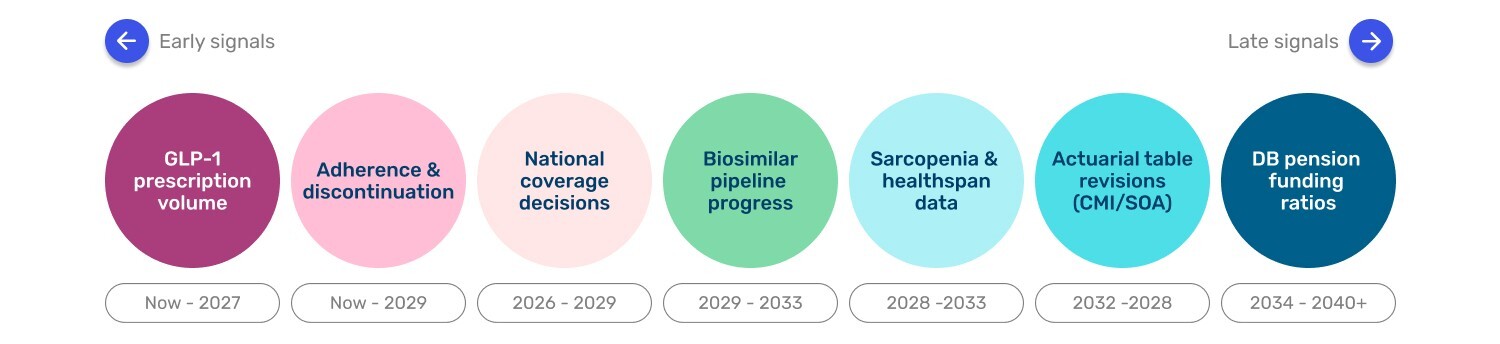
As these trends evolve, we believe investors should watch the following indicators:
Early signals (one to three years)
- GLP-1 prescription volumes – acceleration beyond diabetes into obesity/prevention indications
- Adherence and discontinuation rates – sustained use beyond 12-24 months is a key efficacy indicator
- National coverage decisions – expanded NHS or Medicare coverage for obesity treatment could drive substantially higher adoption. (Note, the US government has entered into pricing agreements with Novo Nordisk and Eli Lilly for Medicare/Medicaid coverage19)
Medium-term signals (three to six years)
- Generic pipeline – progress towards regulatory approvals in the lead-up to patent expirations. (Note, the US Food and Drug Administration (FDA) has already granted tentative approval for a generic semaglutide injection, subject to the resolution of patent and exclusivity barriers20)
- Sarcopenia/healthspan clinical data – evidence from further clinical trials will help clarify whether longer lifespans are accompanied by longer healthspans. (Note, the EVOKE/EVOKE+ phase three trials investigating semaglutide for treating early-stage Alzheimer's disease reported negative results in November 2025)
Late signals (seven to 14 years)
- Official mortality improvement assumptions – a formal revision incorporating GLP-1 data could trigger liability reassessments across relevant national pension systems. This is probably the most important indicator to watch, but it will not be leading
- DB pension funding ratios – financial confirmation that liabilities are being repriced
Figure 1. GLP-1 indicators to watch
Source: Man Group Advisory.
Conclusion: a longevity catastrophe before a boon
The advent of vaccines and then antibiotics marked significant advances in medicine for our species. We believe that GLP-1 receptor agonists could represent a similar structural break for population health – one that the financial system has not yet priced-in. Evidence points to a drug class of significant breadth and potency, capable of reducing cardiovascular mortality, improving metabolic function and with the potential to extend life in ways that no single pharmacological intervention has achieved, at least since statins. The fast uptake, broad demographic reach and clinical versatility of GLP-1s make the actuarial challenge more urgent.
Whether GLP-1s can match earlier medical breakthroughs, and whether longer lives are accompanied by better health, will determine whether their impact is primarily a liability catastrophe or a productivity boon. The timing asymmetry is critical: longer lives immediately increase pension and annuity obligations, while the productivity savings from better health accrue only over decades, if at all.
The first phase of a potential longevity shock (extending into the 2030s before patents expire) is manageable but requires immediate attention. Over the next decade, wider global access and reduced side effects could amplify longevity-related financial risks. Second-phase impacts, driven by the genericisation of GLP-1 therapies, could extend longevity risk further into public pension systems and state social security obligations. This is where the potential for systemic risk lies.
For global allocators, such as pension plans and sovereign wealth funds, these risks can affect both sides of the balance sheet. As ever, the first critical step is to understand longevity risk and to analyse precisely where it sits within portfolios. Those who correctly identify and underwrite longevity risk may benefit materially from the repricing that may lie ahead.
The statin example demonstrates that the pensions industry moves slowly in the face of pharmacological disruption. The difference this time is that we have a historical precedent, emerging clinical data and the analytical framework to act before the liability shock fully materialises. The indicators and analysis set out in this paper provide a roadmap. The opportunity lies in acting before the mortality tables catch up.
1. Source: Global Burden of Disease Study 2021 BMI Collaborators. "Global, regional, and national prevalence of adult overweight and obesity, 1990–2021, with forecasts to 2050: a forecasting study for the Global Burden of Disease Study 2021", The Lancet, Volume 405, 2025.
2. Source: GBD 2021 BMI Collaborators. "Global, regional, and national prevalence of adult overweight and obesity, 1990–2021, with forecasts to 2050." The Lancet, Vol. 405, March 2025.
3. Source: World Obesity Federation. "World Obesity Atlas 2023".
4. Source: Cardiovascular Disease: The SELECT Trial. Lincoff AM, Brown-Frandsen K, Colhoun HM, et al. "Semaglutide and Cardiovascular Outcomes in Obesity without Diabetes." New England Journal of Medicine 2023; 389: 2221–2232. Kidney Disease: The FLOW Trial. Perkovic V, Tuttle KR, Rossing P, et al. "Effects of Semaglutide on Chronic Kidney Disease in Patients with Type 2 Diabetes." New England Journal of Medicine 2024; 391: 109–121.
5. An expansion of indication is regulatory approval to broaden a medicine’s existing uses to include additional conditions, stages of disease or patient groups.
6. Source: kff.org/health-costs/poll-finding/kff-health-tracking-poll-november-2025.
7. Source: Eberly LA, Yang L, Essien UR, et al. "Racial, Ethnic, and Socioeconomic Inequities in the Prescription of Newer Antidiabetic Medications".
8. Source: kff.org/health-costs/poll-finding/kff-health-tracking-poll.
9. Wilding JPH, Batterham RL, Calanna S, et al. "Once-Weekly Semaglutide in Adults with Overweight or Obesity." New England Journal of Medicine 2021; 384: 989–1002. DOI: 10.1056/NEJMoa2032183.
10. Source: Khera R, Wang Y, Nasir K, et al. "Trends in Use of Glucagon-Like Peptide-1 Receptor Agonists and Rates of Discontinuation: A Cohort Study." JAMA Network Open 2024; 7(6): e2417757. DOI: 10.1001/jamanetworkopen.2024.17757.
11. Source: Weiss T, Yang L, Carrig C, et al. "Real-world weight change, adherence, and discontinuation among patients with type 2 diabetes and obesity receiving glucagon-like peptide-1 receptor agonists: A systematic review and meta-analysis." Obesity Reviews. 2023.
12. A method of use patent protects a specific, novel way to use an already existing product, device, or chemical compound.
13. "Avoiding a Longevity Catastrophe", ScienceDirect (2025), "[an extreme longevity scenario] could cause financial distress of certain financial institutions. DB pension plans, insurers and reinsurers with concentrations of longevity risk and low levels of capital are particularly vulnerable".
14. The first statin to obtain regulatory approval was lovastatin (Mevacor, Merck), approved by the FDA in August 1987.
15. Scarborough P, Wickramasinghe K, Goldacre M, Rayner M. "Trends in coronary heart disease 1961–2011." British Heart Foundation, 2011.
16. IMF, Global Financial Stability Report, April 2012, Chapter 4, "The Financial Impact of Longevity Risk". The IMF cites Bongaarts, J. and Bulatao, R. A. (eds.) (2000), Beyond Six Billion: Forecasting the World's Population, National Academy Press.
17. The FDA approved the first GLP-1 receptor agonist, exenatide (Byetta), on 28 April 2005, for type 2 diabetes. Amylin and Eli Lilly launched it in the US that year.
18. The net result for a large, diversified insurance institution is ambiguous because while they may win on the mortality book, if healthspan gains are also made, they may simultaneously lose on the longevity book.
19. The White House, "Fact Sheet: President Donald J. Trump Announces Major Developments in Bringing Most-Favored-Nation Pricing to American Patients", 6 November 2025 (the US government has made obesity treatments available to eligible Medicare beneficiaries through a temporary CMS demonstration running to end-2027, and at the same negotiated price to state Medicaid programmes, which decide whether to cover them).
20. In April 2026, Apotex announced that the FDA had granted tentative approval for its generic version of Ozempic (semaglutide injection), with US market entry remaining subject to final approval and resolution of applicable patent and exclusivity barriers.
You are now leaving Man Group’s website
You are leaving Man Group’s website and entering a third-party website that is not controlled, maintained, or monitored by Man Group. Man Group is not responsible for the content or availability of the third-party website. By leaving Man Group’s website, you will be subject to the third-party website’s terms, policies and/or notices, including those related to privacy and security, as applicable.