Key takeaways:
- Historically, every commodity has had a structural price floor. Artificial intelligence (AI) tokens break that pattern: their pricing has no precedent. This is structural, not a temporary condition of market immaturity
- Any industry whose outputs are priced against the cost of human cognitive labour – such as legal, consulting, research or content – is in the deflationary gravity field of AI tokens
- AI tokens may disrupt markets across the professional services sector and beyond. Software as a service (SaaS) is the canary because it is publicly traded. However, we believe the coalmine is much larger
Introduction
Historically, every standardised, traded commodity – wood, coal, oil, uranium and others – followed a similar pattern. Each represented a new resource, more useful and cheaper than its predecessor, but with a price floor.
Now, for the first time in nearly a century, a new commodity has emerged which breaks this pattern. The AI token is an atomic unit of text that a large language model like Claude or ChatGPT reads and writes, behaving unlike any commodity before it. It has at least two distinct characteristics:
- The underlying input is cognition itself – the AI token is the first immaterial commodity
- Its price is collapsing with no durable floor
This combination – a deflationary commodity that reprices thinking itself – and the wider implications for markets and the economies behind them, remain largely unrecognised outside the technical community. The investment consequences cut in both directions. The divergence between what the commodity helps and what it harms is structural and it will compound over time regardless of near-term sentiment about AI.
In this paper, we examine AI tokens’ commodity characteristics, trace the deflationary mechanism through the industries most exposed, identify where value might migrate to as costs collapse, and draw out the investment implications.
What makes a commodity?
A commodity generally has four features:
- Fungible - one unit is interchangeable with any other of the same specification
- Transparent pricing - prices are visible and are the byproduct of a competitive market
- Feedstock - it is an input to further production rather than being a final good. This is why commodity price changes ripple through economies in ways that consumer goods prices do not
- Infrastructure - spot prices, forward contracts, exchanges, intermediaries and derivative instruments proliferate
Oil remains the defining commodity metaphor because it is an input to every downstream industry simultaneously. The same logic applies to tokens. They are a cross-industry feedstock, not a single-sector one.
The token as commodity
When a large language model like Claude or ChatGPT processes a prompt or generates a response, it does so token by token, with each token corresponding roughly to four characters of English. While a short email might consume a few hundred tokens, a legal document review might consume hundreds of thousands. An autonomous AI coding agent working through a complex task can easily consume millions of tokens.
This matters economically because tokens are the unit on which AI providers bill. The meter runs continuously, and as AI moves from consumer chat into enterprise workflows and autonomous agents, the volumes become industrial.
The key structural criteria for tokens as a commodity are:
Fungibility
A commodity does not require perfect fungibility at inception. Oil grades were highly differentiated before standardisation took hold. A token from GPT-5.5 today is not perfectly interchangeable with one from Gemini or Claude. But the trajectory appears clear. Enterprise buyers already treat tokens as increasingly substitutable across a growing share of workloads, selecting on price and speed rather than on benchmark performance.
Unit pricing and transparency
Token prices are published as per-million-token rates. Major providers post them publicly, benchmark aggregators like OpenRouter track and compare pricing, and large customers negotiate volume discounts. The market infrastructure is emerging rapidly: application programming interface (API) resellers acting as distributors, inference optimisation firms acting as refiners, reserved capacity contracts that look like take-or-pay agreements in energy.
Feedstock role
Tokens are an intermediate input into software applications, automated workflows, white-collar work and, increasingly, other AI systems. An agentic pipeline consuming tokens to generate analysis, code or operationalise decisions is structurally identical to a refinery consuming crude oil to produce finished products. The token is the feedstock; the application is the refinery; the output is the deliverable.
Outside consumer chat interfaces, where unit costs are obscured, sophisticated users and enterprises think in tokenised commodity terms. The anxiety of running out of token budget is the same as when exhausting any consumable resource or commodity. Enterprises have built the infrastructure to match: metering, allocation policies, departmental budgets, usage dashboards.
At Nvidia's 2026 GTC conference, CEO Jensen Huang declared tokens the new commodity, reframing Nvidia as a builder of "AI factories" that produce tokens, rather than a chip company that sells hardware. Days later, at the 2026 China Development Forum, Liu Liehong, head of China's National Data Administration, officially designated "ciyuan" as the Mandarin term for token. The name is deliberate: in Chinese, "ci" means “word” and "yuan" is the currency character – the same character used for the renminbi and for foreign currencies generally.
According to the Financial Times, daily token consumption in China has risen from roughly 100 billion at the start of 2024 to over 140 trillion in early 2026 – an increase of greater than 1,000-fold in two years.1 China is converting cheap renewable electricity into tokens and exporting the output. This is the same resource-into-commodity transformation logic that has defined every prior industrial commodity.
Figure 1. The token explosion
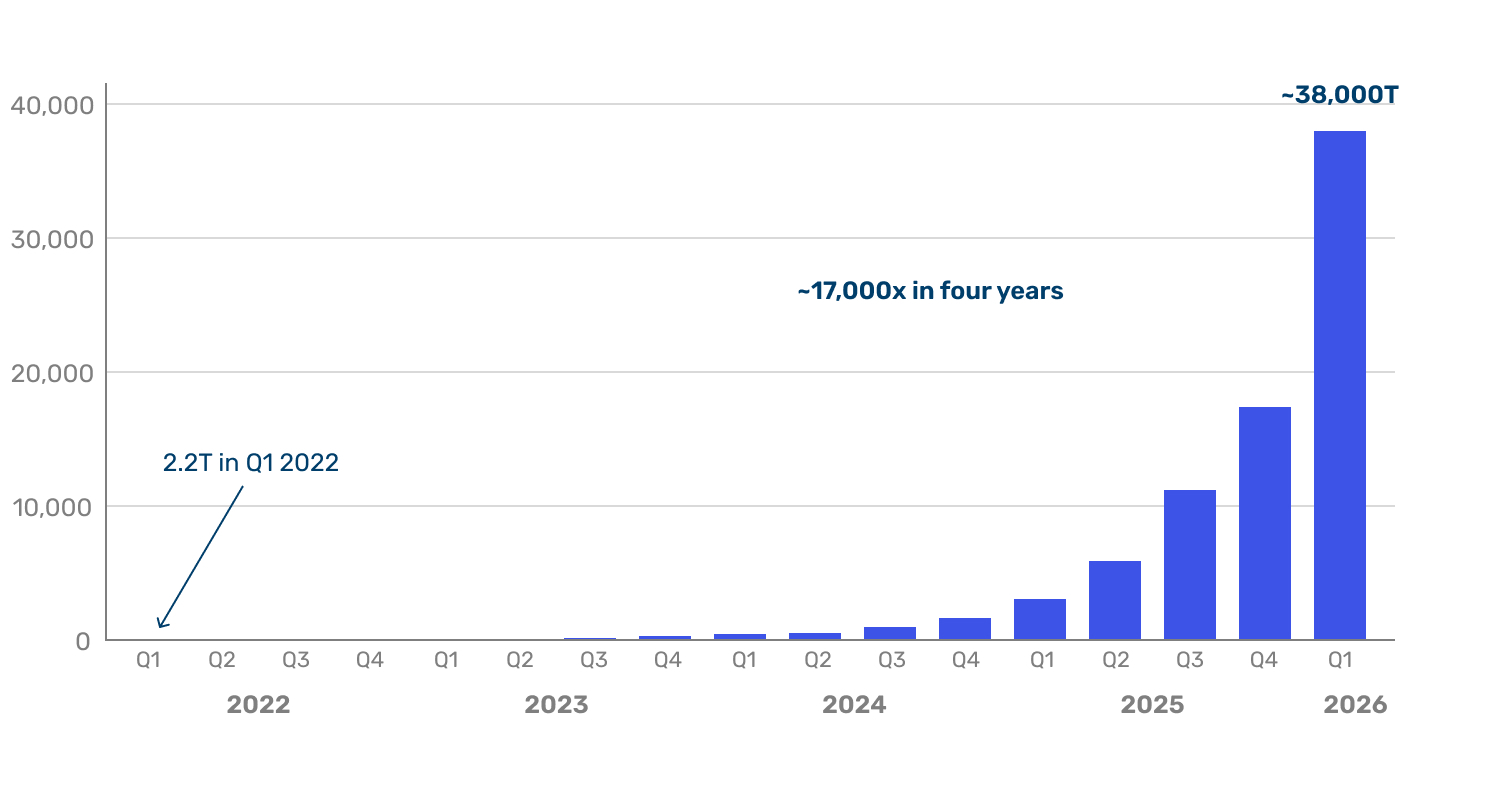
Source: EV Analysis (reported data and announcements); paulkedrosky.com. As of March 2026.
Today, two types of value proposition dominate the AI model market. ‘Closed-source’ or ‘closed weight’ models prevent users from accessing the parameters, or ‘numerical weights’, that capture and display what the model has learned. Users may only ever access the model through the API or the host product. ‘Open-source’ or ‘open weight’ models allow users to download and even modify the weights underpinning the model.
The strategy of leading closed-model companies, such as OpenAI and Anthropic, rests on maintaining value despite token price deflation by preserving closed weights. Their argument has two parts. First, that proprietary model architecture sustains differentiated pricing even as token prices fall. Second, that orchestration of small language models and workflow control – the layer above raw compute (or the underlying computing and hardware infrastructure) – provides the harness above the commodity where a margin will ultimately be earned. On this view, value accrues to whoever owns the best model weights and the platforms built around them.
Chinese open-source development has pursued a different approach. DeepSeek, Qwen and their successors are built on mixture of experts (MoE) architectures, which are ensembles of specialised sub-models that activate selectively depending on the task, routing computation across multiple components rather than pushing every token through the full parameter set. The result is near-frontier performance – within roughly six months of the leading closed models – at a fraction of the compute cost of a dense frontier model.
‘Open-source’ models are structurally more deflationary than their commercial equivalents – once weights are published, inference (or running the model) is available at marginal compute cost, with no licence fee and no API meter running. MoE architectures accelerate this further, lowering the compute floor with every architectural generation.
The closed-model value-capture thesis therefore faces two pressures compounding simultaneously: token deflation eroding the commodity price, and open-source MoE architecture eliminating any inference cost floor.
The ‘hyper-deflationary’ anomaly
Input prices at OpenAI moved from roughly US$30 per million tokens in early 2023 to below US$0.30 for comparable capability by late 2024. The compression has been accelerating, driven by training efficiency, inference optimisation and relentless hardware improvement.
Figure 2. Token price collapse, March 2023 – March 2026
Sources: OpenAI pricing pages (archived); paulkedrosky.com. Input token prices for GPT-4 class frontier models at each major release. Log scale. As of March 2026.
Problems loading this infographic? - Please click here
The mechanism is categorically different from prior commodity deflation. When oil prices fall sharply, producers curtail investment, close wells and end supply contracts which help prices to eventually recover. If the price falls below extraction cost, supply physically cannot be sustained.
Token production is different. Once a model is trained, its weights replicate at near-zero marginal cost. Unlike physical commodities, the deflationary pressure is driven by efficiency gains, not demand. The only conceivable floor is the cost of electricity (at current hardware efficiency, a hundredth of a cent per million tokens and still falling). But since that floor is itself moving down, the deflationary pressure has no practical limit.2
The token is the output being consumed, not an input to manufacturing something else. When token prices fall, the cost of cognitive work falls directly with them, for anyone willing to access the commodity. There is no intermediate manufacturing step, no product layer, no application that must first adopt the cheaper input before the savings reach the person whose work is being priced. The deflationary pressure propagates immediately: the cognitive commodity is not a cheaper input to making something. Rather, it is the product, priced.
Where does value go?
When a commodity becomes cheap and abundant, the value doesn't disappear — it just moves elsewhere:
- To the physical infrastructure through which the commodity flows
- To entrenched workflows and tools built around that commodity that are costly to migrate away from
- To the non-fungible inputs that differentiate the commodity's utility even as its price collapses
In the context of AI tokens, that means:
Infrastructure: the hyperscalers who own the computing layer (data centres, networking, power interconnects) are the new pipeline operators. They earn returns on physical assets regardless of which model runs on them. The commodity price of tokens is irrelevant to their economics, just as crude oil's price is irrelevant to a pipeline tariff.
Orchestration and harnesses: the most immediate beneficiary of token commoditisation is within the application layer, i.e. the orchestration tools, harnesses and agentic environments that sit directly above the raw token and determine how it is consumed. Tools like Anthropic’s Claude Code and OpenAI's Codex do not produce tokens. Rather, they manage the process by which tokens are directed to accomplish complex multi-step tasks. As the token itself deflates toward zero, the value of knowing how to use it intelligently, efficiently and in ways that compose into reliable workflows does not deflate with it. If anything, it increases, because the scope of what tokens can do expands faster than the average user's ability to harness that capability.
The practical consequence is that orchestration tools and agent frameworks are structurally positioned to gain margin as token prices fall. Their switching costs are relatively high. Their value proposition strengthens as tokens get cheaper, because lower input costs make agentic workflows economically viable across a wider range of tasks.
The model providers understand this and are building harnesses. Claude Code, Codex and Google's Agent Space are attempts to own the orchestration layer before it becomes an independent industry. The commodity is the input. The harness is the refinery. Whoever controls the refinery captures the margin that the commodity layer has surrendered.
Context and data: tokens may be fungible, but the context that determines their utility is not. A model operating on a company's institutional architecture – its internal documents, decision history and proprietary knowledge – produces outputs no other provider can replicate and may widen the company’s advantage as token prices fall.
The owners of large, high-quality, irreplaceable bodies of primary-source human output are the refinery's proprietary catalyst. In short, the material that makes the commodity useful cannot itself be manufactured from the commodity.
Figure 3. Value migration map
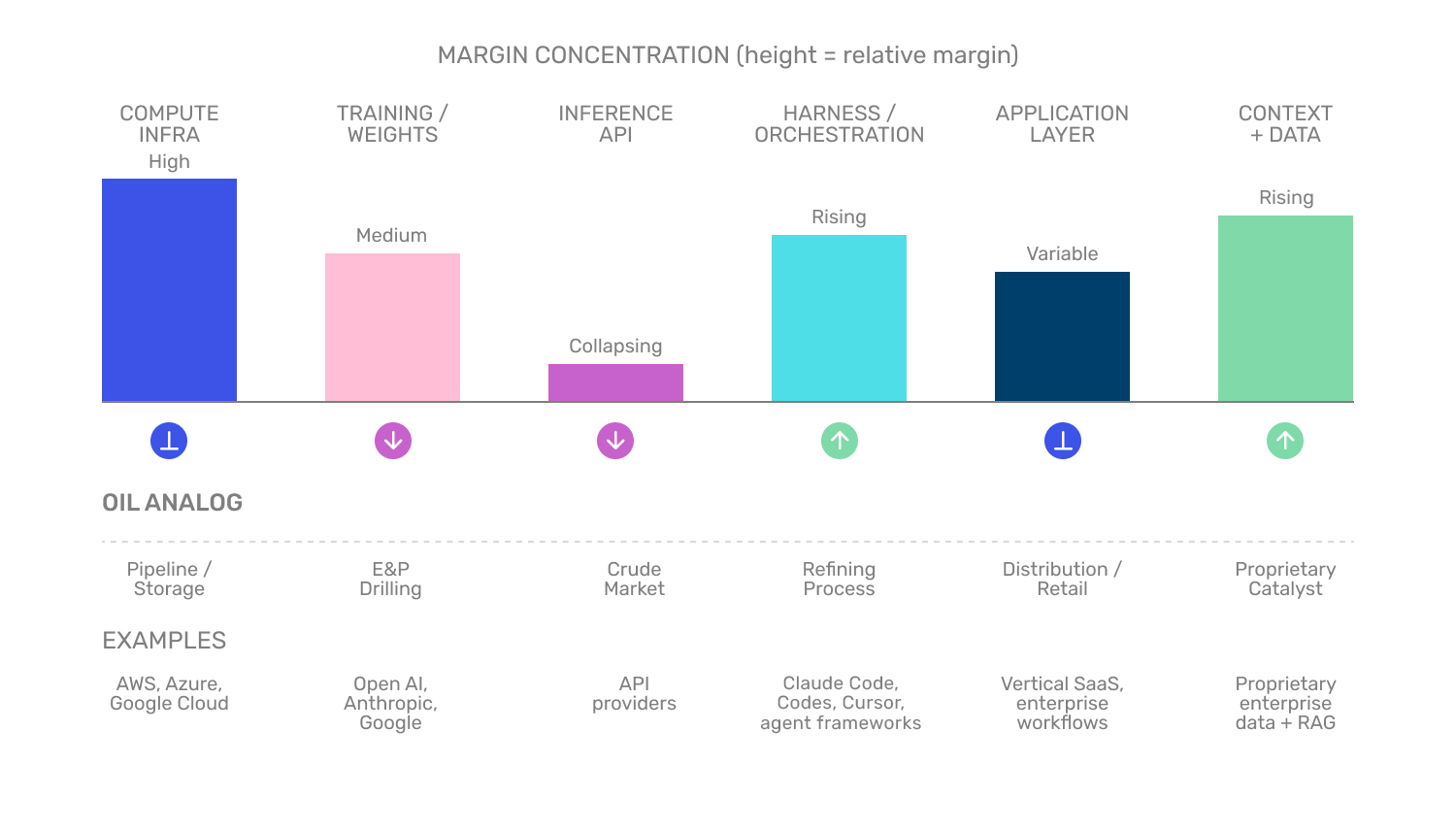
Source: Author’ analysis; paulkedrosky.com. Bar heights are qualitative representations of relative margin concentration, not quantitative measures.
Model providers competing on token price are in a structurally poor position for sustained returns, except for the one or two players – likely in China – who achieve sufficient scale to drive costs below any competitor's floor. The value accrues to the last operator standing, unless they have also managed to own the orchestration layer above the commodity, in which case the commodity becomes a loss leader for a more defensible business.
Figure 4. Source of switching cost and lock-in
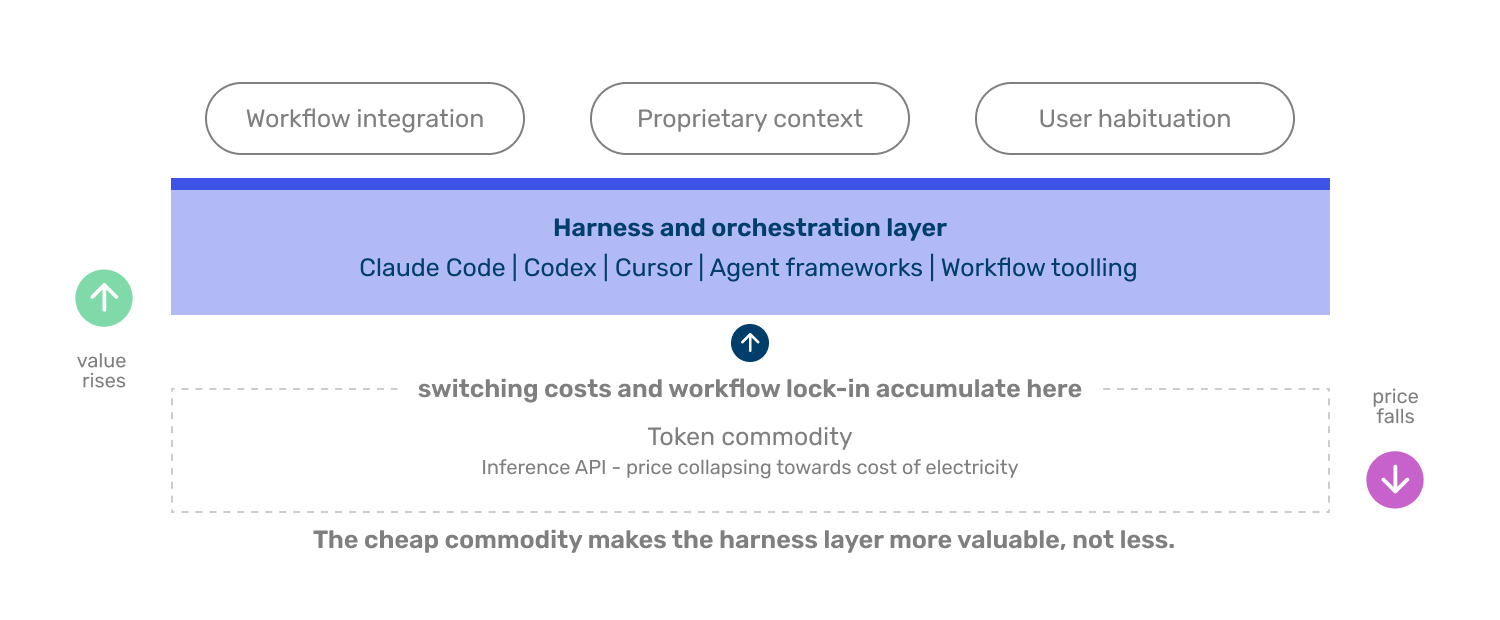
Source: Man Group database.
The cognitive deflationary spiral
SaaS multiple compression has been the most visible early signal of a broader repricing as this commodity emerges. But the mechanism it represents is an economy-wide story about what happens when the cost of cognitive output collapses.
For most of what the knowledge economy does, the value delivered is the product of trained human judgement applied to a specific problem. That is precisely what tokens are beginning to substitute for, at a price that is falling by half or more every 12 to 18 months.
The mechanism here divides along a fault line that runs through every knowledge-economy sector: tokens commoditise structured, rules-based, pattern-recognition work – IQ, in short – efficiently and at scale. However, they cannot replicate taste, senior judgement, genuine creative originality or the capacity to read a room – what we might call EQ.
The industries most exposed to this shift are the core of the developed world's high-margin, high-wage economy. They include:
Professional services: law, consulting, accounting and advisory services are priced on the assumption that trained human judgement is scarce and expensive. Billing rates for junior lawyers and consultants are in large part a markup on the cost of producing people with specific credentials. Token-based workflows do not yet replace senior judgement, but they systematically displace the associate work that consumes the majority of billable hours at every major professional services firm. The junior layer is the first to be compressed, and the junior layer is where the economics of the professional services headcount leverage model live.
Financial services: the back and middle office of the financial services industry is vast and mostly structured cognitive labour. The deflationary pressure arrives not as a sudden displacement, but as a gradual compression of the labour required per unit of output. The forward-looking indicator is already present in the hiring data; some of the major professional services firms have begun materially reducing their graduate intakes.3
Healthcare: the industry’s administrative layer is enormous, expensive and cognitively intensive, but also highly structured. These are tasks with defined inputs, outputs and clear quality criteria, making them among the most tractable for token-based automation. The clinical layer faces a different but related pressure. Diagnostic AI already matches or exceeds specialist performance across radiology, pathology, dermatology and ophthalmology.4 The adoption curve may soon be driven by legal liability.
Education and credentialing: the production of educational content is a cognitive service priced via the cost of human expertise. As tokens produce explanations, assessments and instruction at near-zero marginal cost, the pricing power of content production collapses. Credentialing, the business of certifying that a person has demonstrated knowledge or skill, faces a parallel structural challenge. It has historically priced the scarcity of documented human effort. That scarcity is now in question, posing a structural dilemma the industry may not resolve.
Media and information services: the commodity price of written analysis, a translated document, a summarised report or a standard news article is converging toward the cost of inference. The challenge is that much of what passes for content in the media economy is regurgitation, and the market has not yet worked out how to price the origination premium that remains. The businesses that survive will be those that can credibly demonstrate that their output requires the EQ faculty that tokens cannot supply.
Across all these deflationary waves, the mechanism is the same: a commodity has entered the market, and it substitutes for the core productive input. The substitution may be incomplete; it misses the judgement, relationships and context that constitute genuine EQ work, but in an increasingly machine-to-machine economy, those are not long-term moats. Unlike prior commodity-driven disruptions, the substitution does not require the incumbent to adopt the new input. The client can adopt it directly.
This is the cognitive deflationary spiral. Token prices fall and the cost of producing cognitive outputs falls with them, for anyone willing to use the commodity directly.
The transitional window
Token deflation propagates through markets at the speed of adoption, and adoption is neither instantaneous nor uniform. First movers, the firms that integrate AI into their workflows ahead of competitors, extract transitional margins during the window between their own adoption and that of the broader market.
The size and duration of the transitional window depends on three variables: competitive adoption speed (varies enormously by sector), barriers to entry (contextual moats buy time in the transitional window) and regulatory friction. The last is the most consequential variable, since European regulations that are designed to protect workers from the consequences of AI displacement may, in practice, ensure that the value generated during the transitional period flows disproportionately elsewhere.
For the structural shorts – junior cognitive labour and workflow SaaS – the entry timing matters. In sectors where adoption is slow and regulatory friction is high, transitional margins are still being earned.
Investment implications
The commodity framework generates positions that cut against the consensus AI investment narrative. The most discussed plays – the hyperscalers, the model providers and the infrastructure buildout – sit in the ambiguous or short columns.
On the plus side, obtaining a reliable electricity supply (to power data centers and their graphics processing units (GPUs)) is a genuine competitive advantage. However, companies must be financially strong enough that their balance sheets can absorb write-downs; and they are still exposed to capital expenditure cycles underwritten at higher token-price assumptions). Capex is justified assuming a certain revenue per token, and if that assumption breaks, the investment case weakens even if the company can technically absorb the losses.
The structural longs are less visible: the orchestration layer, the owners of proprietary context and primary-source data, the energy infrastructure that will create comparative advantages, the private equity operators willing to use AI to aggressively cut human costs.
Conclusion: just the tremors
Every industrial commodity in history created disruption by making something cheaper. Coal made heat cheaper. Oil made transport cheaper. Electricity made light and mechanical force cheaper. In each case, the commodity was an input to something else: it lowered costs upstream and the benefits propagated downstream.
The token is not bounded in the same way. It does not cheapen an input to production. For the industries that constitute the developed world's highest-value economic activity (law, finance, medicine, research, consulting, software, media) cognition is not an input. It is the product. What tokens reprice is the thing itself.
Every pricing model in professional services rests on the assumption that cognition is expensive because it is scarce. Yet tokens do not require credentials. They do not require salaries, benefits or training cycles. They only require electricity.
As we have shown, the disruption to that economy is already visible. But these are just the tremors, with the commodity still early in its deflationary arc.
What survives the repricing is the category that tokens cannot handle: taste, genuine creative originality, wise judgement. As the analytical layer is stripped from the value chain, this other form of intelligence becomes scarce in a way it was not before.
We believe the AI token era will not be defined by who produces the commodity. It will be defined by what happens to everything priced against the cost of cognition when cognition becomes, effectively, free. Once that happens, we will finally see what has been genuinely irreplaceable all along.
1. Liu Liehong, head of China's National Data Administration, during the China Development Forum on 23 March 2026. The data has also been supported by figures from China's National Bureau of Statistics and has since been widely cited across global financial media.
2. Energy is largely irrelevant as a limiter on token deflation. The only scenario in which energy could matter is a sustained, multi-year disruption to power pricing — nationalised grids, prohibitive carbon taxation, prolonged outages — coinciding with a plateau in efficiency gains. Energy matters to the AI story in a different and more specific way: as a capacity and political constraint on the infrastructure buildout, as a source of competitive advantage for regions with access to cheap and reliable power, and as a fixed-cost dimension of the capital structure trap that mid-tier operators cannot escape when token revenues fall. It does not set the commodity price.
3. Source: Big Four firms cutting grad jobs in favour of AI | Accountancy Today
4. Source: Artificial intelligence-driven transformative applications in disease diagnosis technology - PMC
You are now leaving Man Group’s website
You are leaving Man Group’s website and entering a third-party website that is not controlled, maintained, or monitored by Man Group. Man Group is not responsible for the content or availability of the third-party website. By leaving Man Group’s website, you will be subject to the third-party website’s terms, policies and/or notices, including those related to privacy and security, as applicable.