Key takeaways:
- Three forces will define 2026 for hedge funds: geopolitics, the next Federal Reserve (Fed) chair, and AI. Rather than making directional calls, we see these forces creating a volatile backdrop, ripe for alpha generation in single-stock selection over thematic bets
- We have upgraded three strategies to positive: Long-Biased Equity Long/Short, Market Neutral Equity Long/Short, and Merger Arbitrage, reflecting elevated dispersion, record M&A activity, and late-cycle dynamics that favour active managers
- Markets remain complacent about tail risks: from Greenland to potential politically motivated liquidity floods ahead of midterm elections, investors are treating these risks as too difficult to price – a stance we believe creates opportunity for significant volatility
1. Introduction
For us, there are three key themes that will drive markets in 2026: geopolitics, monetary policy (in particular, the next Fed chair), and AI. As ever, we will try to avoid the temptation of trying to predict the direction of equity markets, but we believe these three drivers will help to set the backdrop for hedge fund opportunities and risks over the coming year.
- From a geopolitical perspective, 2026 started with the US seizing Venezuelan President Nicolás Maduro, leaving a potential power vacuum in Latin America and raising questions over the legitimacy of its actions. Few observers can be left in any doubt that we are now in an era where unilateral military strength outweighs the value of treaties and the international rule of law. Such a backdrop inevitably deemphasises the role of structures such as the United Nations and NATO, leaving the shape of the future world order uncertain. The market reaction to these events has been typically muted. Geopolitical developments tend not to bother markets most of the time – unless the actions are sufficiently large as to directly impact the broader profitability of the corporate sector, in which case only those parts of the market explicitly linked to the event seem to be affected (for example the confinement of material market moves to Venezuelan assets and oil majors recently). The market narrative seems to be that any gradual deterioration in global security and stability is just too hard to price, so best to ignore it. We believe this is complacent and are watching situations, such as a potential US invasion of Greenland, as a harbinger for much wider market volatility.
- On monetary policy, the biggest point of focus is likely to be the announcement of the next Fed chair in early 2026 (at the time of writing, this is still unknown). The announcement of criminal proceedings against Jerome Powell shows that the war of words continues to escalate, but markets are likely to be more driven by genuine monetary action rather than sabre-rattling. The path that concerns us most is the imposition of a Trump-friendly chair in the second quarter, leading to accommodative policy that will flood the market with liquidity in a politically motivated move ahead of the midterm elections. Any analysis of the term premium in longer-dated US debt suggests that government bond markets are complacent about these risks. A material steepening of US yield curves, with a commensurate pickup in inflation expectations, would presage continued policy volatility for the next few years.
- But arguably the most market-sensitive of the three themes is AI. It is both highly impactful and highly unpredictable. Technology (both hardware and the models themselves) continues to improve, and the volume of 'compute' capability continues to accelerate strongly as more data centres come online. The rate of change in AI is so rapid that we think 2026 will be a pivotal year. While immediate impacts may not materialise, our understanding of the likely trajectory will improve significantly. The key point is that it doesn't really matter what one's view is on AI in 2026 when considering the environment for alpha generation. Whether you are an AI bull or bear; believe we are in a data centre super-cycle or a period of dangerously lax rigour around capex; or think AI will lead to utopia or material risks to humanity – it feels that any path from here will produce significant single-stock winners and losers, driving material index volatility. Instead of taking a directional view on the unstable broader picture around AI, we are more comfortable playing the alpha angle rather than betting on thematic beta.
2. Our Outlook
Hedge fund performance was uniformly strong across 2025, despite pockets of difficulty for individual strategies at different points of the year. The most challenged strategy was Trend Following, which suffered losses around the 'Liberation Day' market gyrations but recovered strongly towards the end of the year.
We expect that the broadly positive environment for alpha generation will continue. As noted in our introduction, the world remains a volatile and uncertain place, and from this we expect to see significant volatility at both the asset class and security level. We expect to see a continuation of late-cycle dynamics associated with elevated fundamental pricing: namely, high levels of corporate activity including mergers and acquisitions (M&A) and greater differentiation between winners and losers in key market themes.
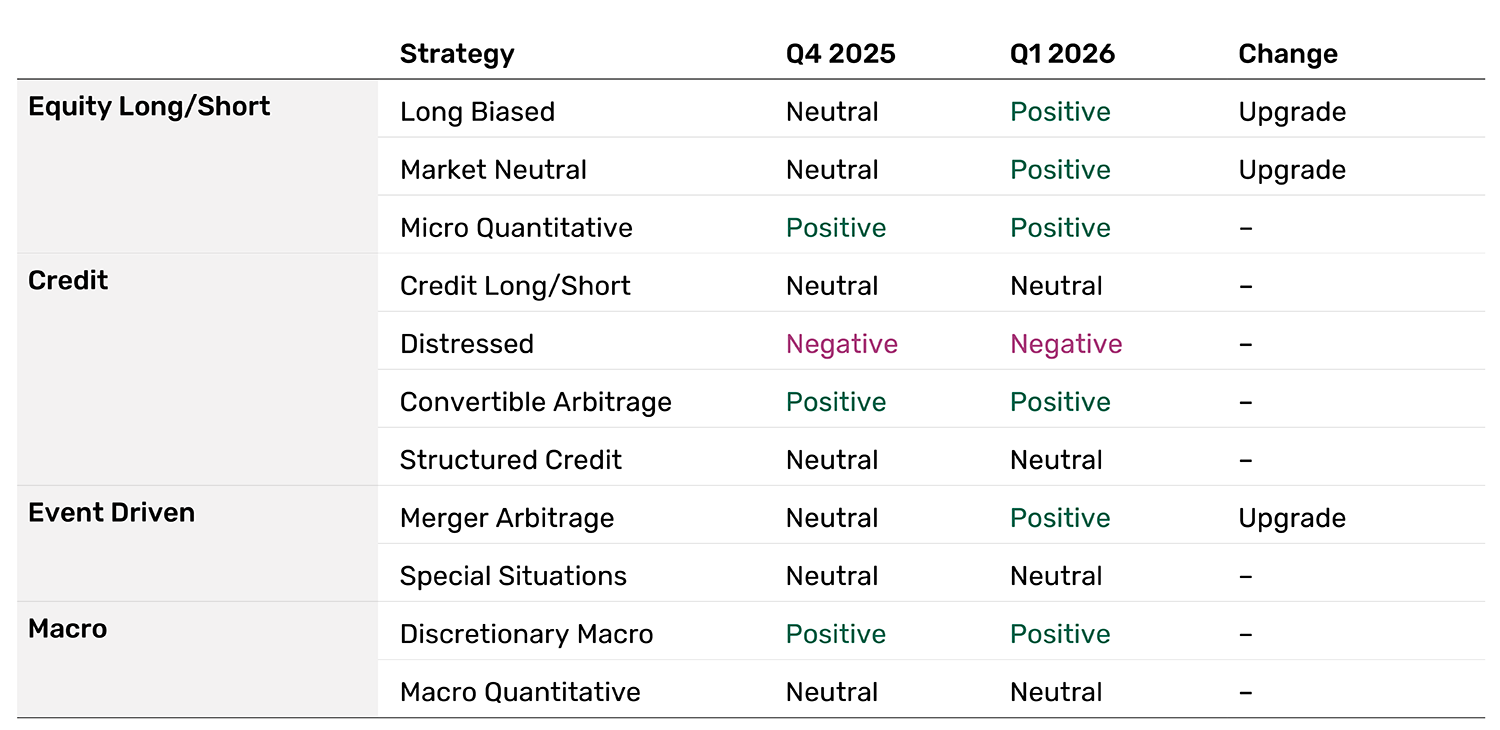
We believe that the hedge fund industry will continue to offer investors an important source of diversification from both liquid and illiquid asset class exposures and therefore have upgraded our outlook for three strategies: Long-Biased Equity Long/Short, Market Neutral Equity Long/Short, and Merger Arbitrage. The only strategy with a negative outlook is Distressed Credit, where it remains too early to have an attractive risk-reward trade-off in many of these situations.
Figure 1 summarises our stance on different hedge-fund strategies for Q1 2026.
Figure 1. Q1 2026 Outlook Versus Q4 2025 Outlook
3. The Details
3.1 Equity Long/Short
Our most notable change as we move into 2026 is to upgrade our outlook for Equity Long/Short to positive, for both long-biased and market-neutral implementations of the strategy. However, while we are now positive on long-biased equity long/short strategies, we are focusing on the alpha-generation capabilities of these managers and are firmly not making a call on the overall equity market. We continue to have material concerns that parts of capital markets, particularly those associated with AI capex, are pricing off nebulous forecasts of long-term profitability of intrinsically uncertain business models. These valuations are inevitably subject to a high degree of error (on both sides). Therefore, we are more comfortable backing the best hedge funds to pick winners and losers than attempting to call overall market direction.
Opportunities:
- Global equities continue to be marked by higher dispersion and lower single-stock correlations while technological innovation and government policy shifts have created volatility; both are generally constructive for alpha generation
- Policies (e.g., tariffs, One Big Beautiful Bill Act), fiscal reform, and diverging rates may lead to favourable opportunities for alpha versus beta, depending on region and/or sector
- Earnings continue to be key events with stocks being punished severely for missing; however, price movement outside of this continues to be largely theme-driven
- Elevated gross leverage levels suggest managers are comfortable deploying risk in this environment, although this is not historically a strong leading indicator of alpha generation
- US businesses have seemingly adapted well to tariffs but have shouldered a heavy burden; the longer-term sustainability of some business models in the new tariff environment remains questionable
Risks:
- Growing amount of capital invested in multi-manager structures and heightened separately managed account (SMA) usage have both reduced barriers to entry in Equity Long/Short (ELS) and contributed to an uptick in crowding
- Increased concentration in crowded names may intensify the severity of reversals, particularly if these are driven by a pullback in common themes or sectors
- In particular, the AI theme is likely to continue driving markets in the short term, and managers may find it difficult to diversify away from this risk
3.2 Credit
We have maintained all our sub-strategy outlooks in Credit, namely a positive outlook for Convertible Arbitrage, a negative outlook for Distressed and a neutral stance on Credit Long/Short and Structured Credit.
Opportunities:
- We continue to believe that the long-vol nature of Convertible Arbitrage, particularly around companies linked to the AI theme will be a source of alpha, from both new issuance and from gamma-trading around single stock volatility driven by retail investors
- Credit markets are starting to see more activity in traditional areas such as Investment Grade and High Yield, with some Credit Long-Short managers increasing exposure
- Credit event trades, such as balance sheet restructurings, remain a good source of alpha, although the volume of opportunities appears to have reduced recently
Risks:
- The overriding risk in Credit strategies currently is the global tightness of spreads and the apparent lack of connection between credit spreads and market risks
- Within Credit markets, hedge fund managers are noting the difficulty of shorting individual names, as the least attractive credits can tighten further during the frequent junk rallies observed during 2025
- Structured Credit yields are sufficiently low that the only way to compensate for illiquidity is through higher leverage, thereby increasing downside risk
3.3 Event Driven
We have lifted our outlook for Merger Arbitrage to positive and maintained our position on Special Situations at neutral. It is usually (but not always) the case that a more conducive environment for mergers (i.e., tighter spreads) leads to more activity. Hedge funds would like to see both wider spreads and more activity, but this is often too much to wish for. We currently see extremely high levels of activity, but slightly tighter than average spread levels. After much deliberation, we have concluded that the best managers now have a broad enough universe of possible deals to generate attractive returns despite the tighter overall spread, and hence have raised our outlook.
Opportunities:
- M&A activity continues to increase dramatically, with announced deals up over 65% on a year-on-year basis. The US looks particularly strong, with an increased urgency for firms to contemplate more aggressive deals under the current Trump administration and before the midterm elections later in the year possibly restrict the currently permissive environment
- The global antitrust environment is also broadly supportive beyond just the US. The UK has been more supportive of cross-border deals than previously, and Japanese M&A continues to increase
- Most transactions globally have been strategic deals with acquiring companies paying a premium (rather than divestments from existing corporate structures)
Risks:
- Merger Arbitrage spreads remain tight, with managers also focusing on shorter and safer deals which can exhibit the worst degree of skew in periods of stress
- Managers are also generally increasing leverage levels to enhance overall returns, which again raises questions around the size of possible drawdowns in periods of market shock
- Continental European M&A activity remains somewhat subdued, and cross-border activity between Europe and the US remains at risk of political interference more than other regions
3.4 Macro
We have maintained our positive outlook for Discretionary Macro and our neutral stance on Systematic Macro. There has been little in the way of news flow over the last three months to dissuade us from the opinion that the world remains a volatile place, from both a geopolitical and economic perspective. We continue to work through a rewriting of the world order; of a possible depletion of US exceptionalism, and of a possible return to a world of multipolar influences. These transitions are seldom smooth, and we expect discretionary hedge fund managers to benefit from the uncertainty.
Opportunities:
- We remain in a macro-driven environment where tariff uncertainty, fiscal largesse, sticky inflation and labour market concerns remain top-of-mind for investors. Discretionary Macro can generate alpha from divergent economic performance and policy responses
- We continue to like emerging markets amid elevated bond yields and developed market (DM) policy easing, though a 'beta-driven' outlook remains a risk
- Fixed Income Relative Value funds can continue their recent run of performance, with the end of US quantitative tightening (QT), changing issuance dynamics and an expectation for more rangebound DM bond yields supporting the opportunity set
- Commodity strategies can benefit from easing macro uncertainty, with bottom-up factors set to gain relevance
Risks:
- The Quantitative Macro space remains in a state of flux, despite strong returns from Trend-Following strategies in the fourth quarter of 2025. Strategies may take some time to adjust to the new market regime; in particular, unique events arising from geopolitics can sometimes be harder to trade for models trained to spot patterns in previous data
- Discretionary Macro approaches can sometimes behave best in a period when traditional risk assets are falling. If we see a continuation of the equity rally into 2026, then Macro managers face the choice of either cutting risk and accepting lower returns, or aligning with traditional risk factors and sacrificing their diversifying characteristics. This is an ever-present dilemma, but the current narrowness of the market narrative at any one time (focused on, say, geopolitics or AI) means it is particularly acute
You are now leaving Man Group’s website
You are leaving Man Group’s website and entering a third-party website that is not controlled, maintained, or monitored by Man Group. Man Group is not responsible for the content or availability of the third-party website. By leaving Man Group’s website, you will be subject to the third-party website’s terms, policies and/or notices, including those related to privacy and security, as applicable.