Bonds have been getting a lot of bad press lately. It’s been a volatile few weeks, with concerns around inflation, fiscal (un)sustainability, and the equity-bond correlation pushing US borrowing costs to their highest in almost 25 years last week. The turmoil also spilled over into European sovereign bonds. Are these risks real? Absolutely. Does that mean bonds no longer deserve a place in a long-term portfolio? We don't think so.
There are many reasons to have a strategic allocation to bonds, not least of which is their tendency to do well when equities fall, as we’ve previously noted here and here. We’re not going to repeat ourselves, and we’re not sure that people will listen because the current overarching narrative is that inflation is going to stay ‘higher for longer’ and that this is bad news for bond holders. We’re not so sure.
We crunched some numbers and our analysis found that when inflation has been between 2%-4% (as it is now), 10-year US Treasuries have historically delivered an average annualised return of 4% above inflation, a long way from the bad press bonds have been getting. Increasing inflation tends to hurt bonds returns, but the fact that inflation is above target does not, itself, presage a poor period for owning bonds.
We looked at rolling three-month periods going back to 1900, sorted by the level of inflation at the start of each period and by how much inflation changed by the end of it. For each combination, we calculated the annualised return to 10-year US Treasuries over that same window.
Figure 1. How US Treasury returns have moved with inflation since 1900
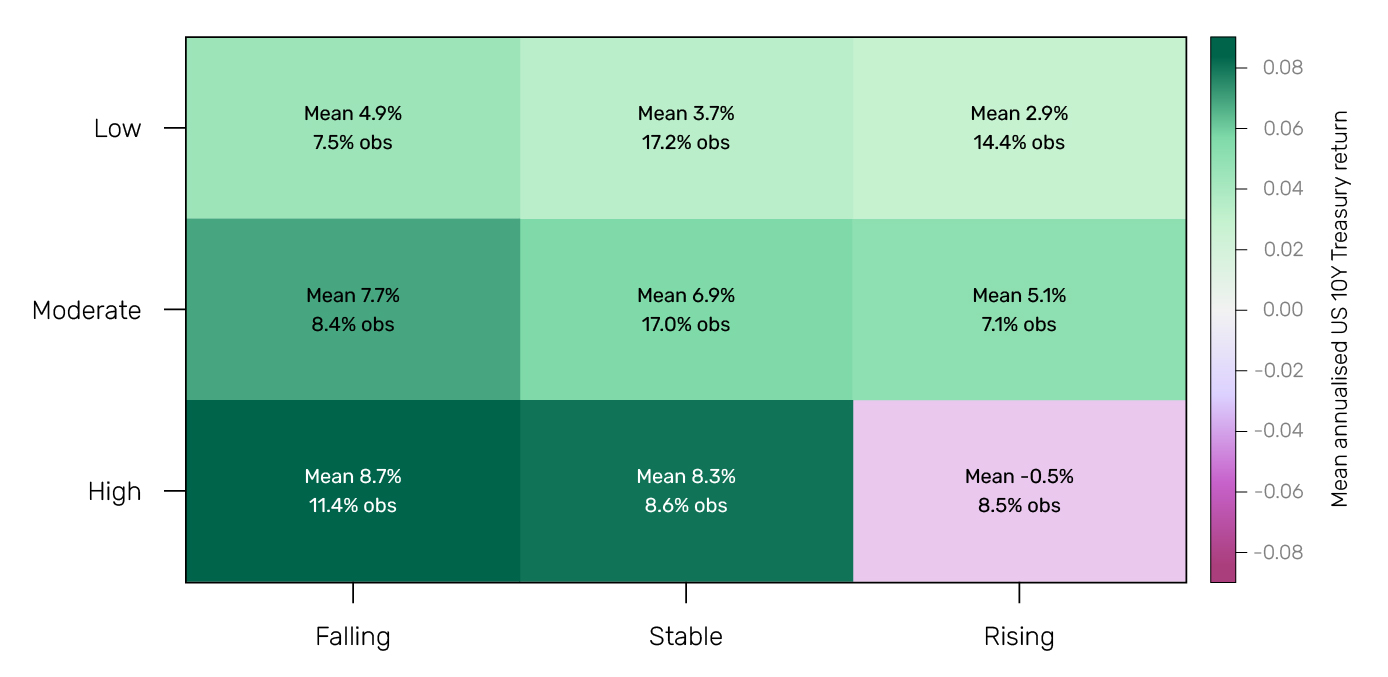
Source: Man Group analysis, as at 11 September 2026. Inflation levels use headline US CPI YoY: low <2%, moderate 2-4%, high >4%. Inflation change buckets use the change in headline CPI YoY over the forward three-month window: stable is within +/-0.50%; moves below that are falling and moves above that are rising. Cells show mean annualised return and percentage of observations. All heatmaps are coloured by mean annualised return. Analysis date range: 1900-2026. Past performance is not indicative of future results.
The nominal returns bear out that elevated inflation is not itself necessarily bad for bonds. When inflation falls from a high starting point, bond returns can be very attractive, partly because starting yields are high. With US inflation currently at 3.4%, we are sitting in the middle row of the table.
However, nominal bond returns don’t tell the whole story. What ultimately matters to investors is purchasing power, rather than the size of the return itself. To that end, the chart below repeats the same analysis using real returns, which are in excess of inflation.
Figure 2. How US Treasury purchasing power has moved with inflation since 1900
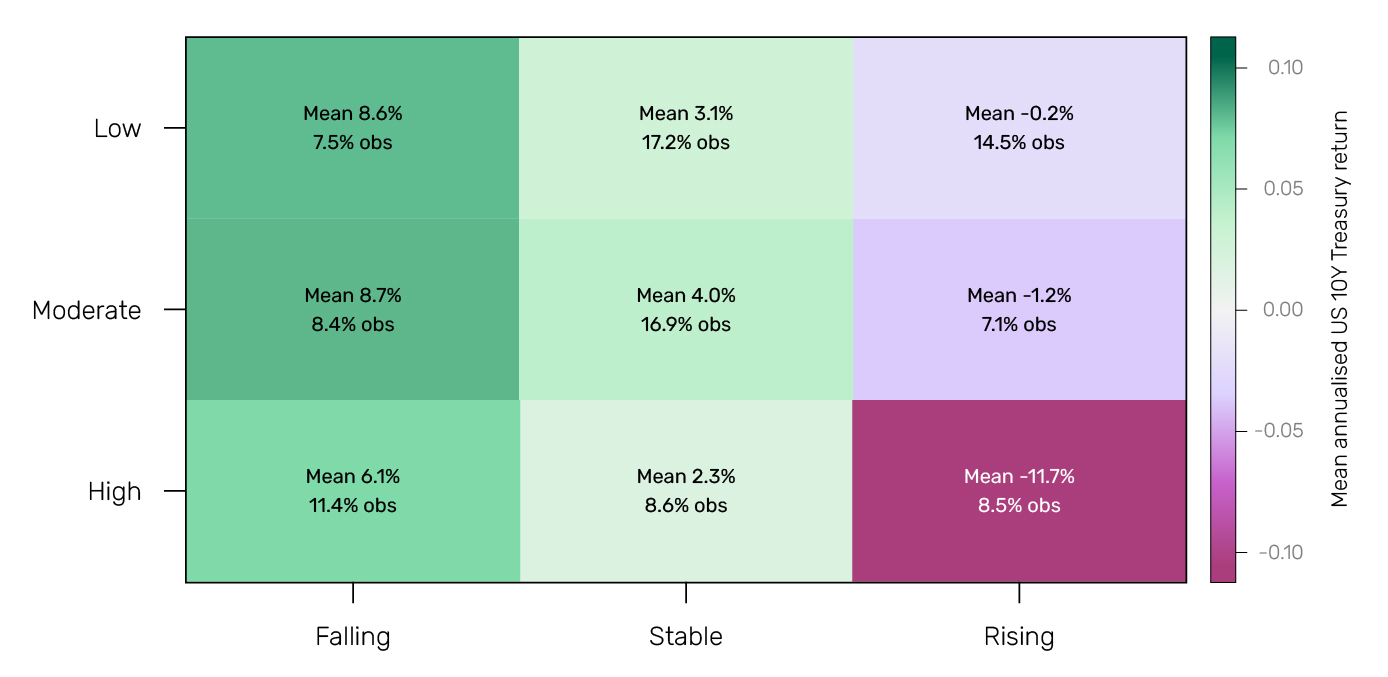
Source: Man Group analysis at 11 September 2026. US Treasury real returns calculated by adjusting US Treasury nominal returns with headline US CPI YoY. Buckets calculated in the same way as Figure 1. Past performance is not indicative of future results.
Real returns tell a similar story, with one exception. Even in moderate or high inflation environments (where CPI is above 2% or 4%, respectively), real returns to bonds can be very positive. The picture changes when inflation is already above 4% and rises by more than 50 basis points (bps) over three months. In that scenario, real returns to 10-year Treasuries have averaged -11.7% annualised. This was experienced in 2022, when inflation jumped and deeply negative real yields at the start of the year compounded the damage.
A ‘higher for longer’ world does not require inflation to keep rising at pace. We believe inflation could remain where it is, or move even higher, without being bad news for bonds. We are currently in the moderate inflation band, where stable inflation implies a real return of 4% annualised to 10-year US Treasuries. Even the ‘high and stable’ category in the chart above, where inflation begins above 4% and moves by no more than 50bps in either direction over three months, has historically delivered an average annualised nominal return of 8.3% and a real return of 2.3% for 10-year US Treasuries.
That does not mean ignoring the risk of another inflation surge. Diversification and risk management remain key. Allocating to commodities alongside equities and bonds may improve diversification and specifically reduce inflationary risk. Momentum strategies may also help. Historically, they have been among the more resilient strategies in inflationary times, as discussed in our papers What Works When Infllation Hits and The Best Strategies for Inflationary Times,[1] which show both findings holding up across eight historical inflationary episodes between 1941 and 2008.
In summary, we don't believe you should write off bonds just yet. They have historically done well when equities fell, and (far from being doomed in a ‘higher for longer’ world), they can still deliver positive real returns.
Authors: Peter Weidner, Principal Quant, Head of Total Return Strategies; Tom Frith, a quantitative researcher, and Tarek Abou Zeid, Partner and Head of Client Portfolio Management within Systematic at Man Group.
[1] Neville, H., Draaisma, T., Funnell, B., Harvey, C.R. and van Hemert, O. (2021), 'The Best Strategies for Inflationary Times', Journal of Portfolio Management.
You are now leaving Man Group’s website
You are leaving Man Group’s website and entering a third-party website that is not controlled, maintained, or monitored by Man Group. Man Group is not responsible for the content or availability of the third-party website. By leaving Man Group’s website, you will be subject to the third-party website’s terms, policies and/or notices, including those related to privacy and security, as applicable.