The short answer is yes, and it has little to do with the banks themselves which remain in good health.
We think investors have grown so hungry for yield that they are piling into some of the market’s most complex bonds without pausing to weigh what they are taking on. The latest to flash red from a valuation perspective are AT1s. Created after the 2008 crisis to make a bank's own investors, rather than taxpayers, absorb losses when it runs into trouble, AT1s sit near the front of the loss queue and pay a higher yield in return.
The additional compensation these bonds pay over safer bank debt has fallen to close to the lowest level observed since these bonds became a market just over a decade ago. Banks have seized the moment, with some locking in a decade of funding at a record pace and with little pushback from investors. The concern is that buyers are waving through risks the shrinking yield no longer pays them for.
Figure 1. Everything is tight but the AT1 spread is close to the tightest in history
Source: : ICE BofA indices, daily OAS. AT1 indices (COCO, COCE, COCU) from Jan-2014; all other indices (ELT2, EBSL, EBBA, C0P0, ER00) from Dec-1999. Percentiles measured against each index's full available history. Data as of 30 June 2026.
Problems loading this infographic? - Please click here
What makes AT1s unique?
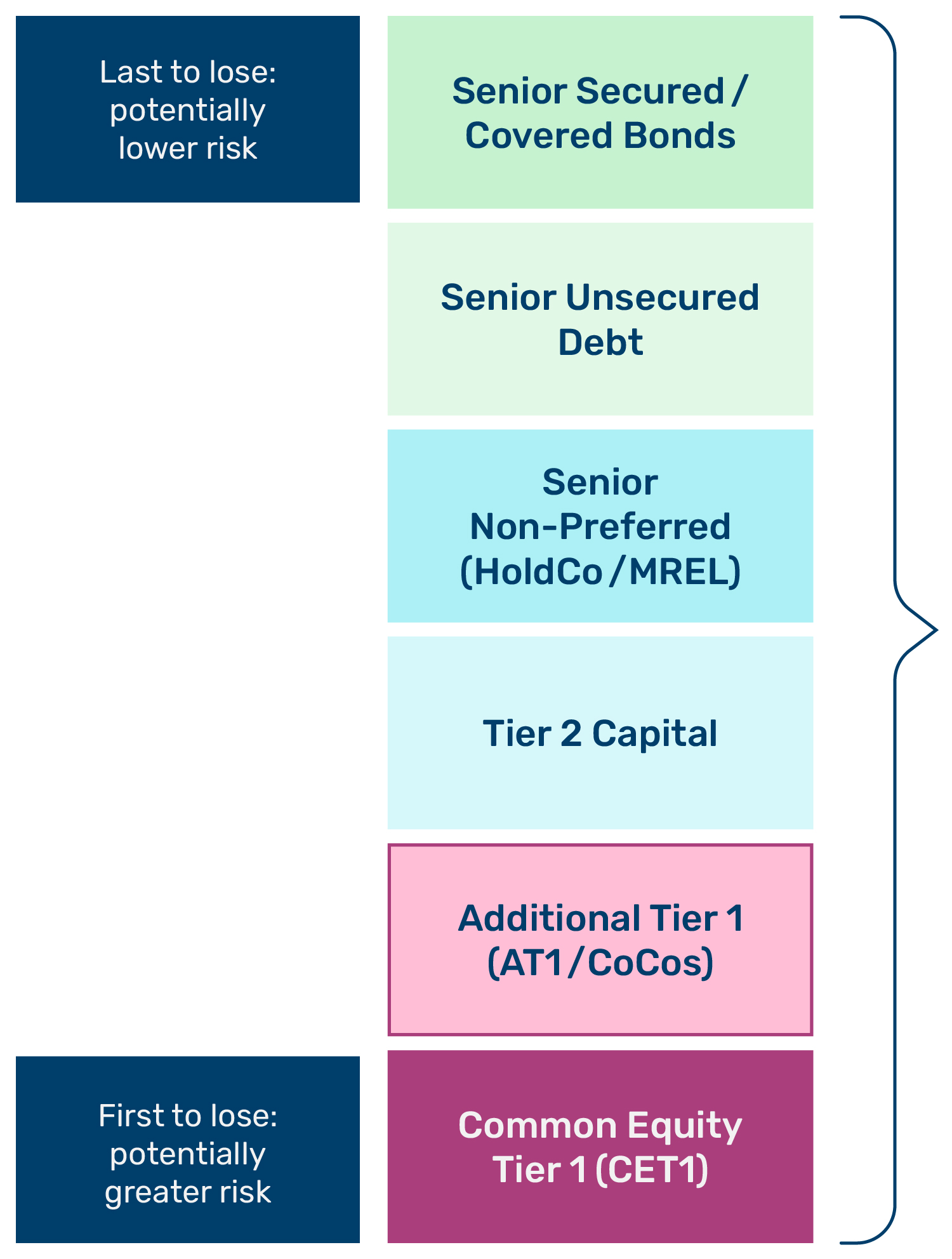
Over the last 12 years AT1s, part of the contingent convertible (CoCo) family, have become a popular way to add yield. They sit just above equity and behind senior creditors in a bank's capital structure (see Figure 2). What makes them unique is that coupons can be skipped at the bank's discretion without triggering default, and if capital ratios breach set triggers, the principal can be written down or converted to equity. They are also more price-volatile than most bonds.
Nearly all European banks issue them, and they have grown into a key part of the bond market, held across an array of credit vehicles from high yield funds to specialised products, with over US$300 billion outstanding, according to the ICE CoCo Index.
Figure 2. Bank debt structure
The four key risks
Whilst these bonds can play a useful role in a portfolio, there are some key risks worth weighing.
1. The bonds have rarely paid so little for the risk
Again, using the ICE CoCo index as a proxy, the spread on these bonds is currently 206 basis points compared to a median of 385bps. Investors are now being paid very little for the additional complexity of the asset class.
2. The bond may not be repaid when expected
A bank need not repay, or call, an AT1 at its first call date, usually after five years. If it does not, the bond’s maturity extends and the coupon it pays steps up. Many recently issued AT1s have low reset spreads locked in from tighter markets, and because those levels now sit below what banks would pay on new debt, it makes sense for issuers not to call. The bonds then become effectively perpetual, with a duration of 15 to 20 years, four times what was first priced in.
The result is typically limited upside but amplified downside, what the market calls negative convexity. Should markets sell off, the bonds with the lowest reset spreads would be expected to suffer the deepest drawdowns.
3. Duration is rising regardless
Even setting the call question aside, duration is climbing. Almost a quarter of all bank AT1s issued this year carry a ten-year non-call period, double the traditional five. The index’s sensitivity to interest rates, its duration, has drifted up to 3.7 years, from 2.3 in 2023. Many national champions have borrowed for double the usual term at low coupons this year, meaning investors are taking on more interest rate risk from AT1s, on top of their other complexities.
4. The documentation is not uniform
One of the least highlighted risks is the divergence in bond documentation and the subsequent impact on investor protection.
Some AT1 prospectuses contain language allowing the trigger level (threshold at which the bonds may be converted into equity) to automatically adjust upward without bondholder consent. This is structurally more dangerous for holders because this enables the issuer to effectively move the goalposts while the buffer between current CET1 and the trigger narrows. Meanwhile, other AT1 securities which offer more bondholder protection, require a supermajority of holders to approve any amendment to the trigger level.
This kind of difference does not show up at the index or headline spread level. It shows how a bottom-up investor willing to do the necessary due diligence can add value.
Parting thoughts
We believe AT1s have quietly shifted from a bet on a bank's health to a bet on interest rates. With spreads this thin and durations this long, the key return drivers are rate moves and not the fortunes of the issuer. Investors drawn in by the yield are focused on the income and not the potential risks underneath. None of this makes AT1s fully un-ownable, but it likely makes them a market for the discerning, not the desperate.
Authors: Alan Bowe, a Portfolio Manager, Discretionary Credit; Hugo Richardson, Client Portfolio Management Analyst and Jon Lahraoui, Director, Discretionary Credit at Man Group.
Note to our readers: We hope you are having a good summer. Our regular Views from the Floor column will take a holiday throughout August. The column will return on Tuesday, 1 September 2026.
You are now leaving Man Group’s website
You are leaving Man Group’s website and entering a third-party website that is not controlled, maintained, or monitored by Man Group. Man Group is not responsible for the content or availability of the third-party website. By leaving Man Group’s website, you will be subject to the third-party website’s terms, policies and/or notices, including those related to privacy and security, as applicable.