Suppose you’ve already taken the time to uncover potential overlapping holdings and other pitfalls when trying to diversify an equity allocation. The next question seems almost too obvious: how are you investing? That is, beyond looking at what you may own in your equity sleeve, how are you approaching your overall equity strategy?
It’s easy to get caught up in stock picking. It’s fun to see what makes companies tick after all, and some people may have strong emotional ties to or conviction in a certain firm or product. Yet, we think it’s just as important to remember that talking about stocks often focuses more about where (or in what) one invests and not necessarily in the how, particularly how an equity investing strategy seeks returns as a whole. A conventional equity fund may rely largely on the shares it owns gaining value. Other approaches may look for opportunities in the relative differences between companies, prices or market relationships. That distinction creates scope for diversification within equities.
One market, different questions
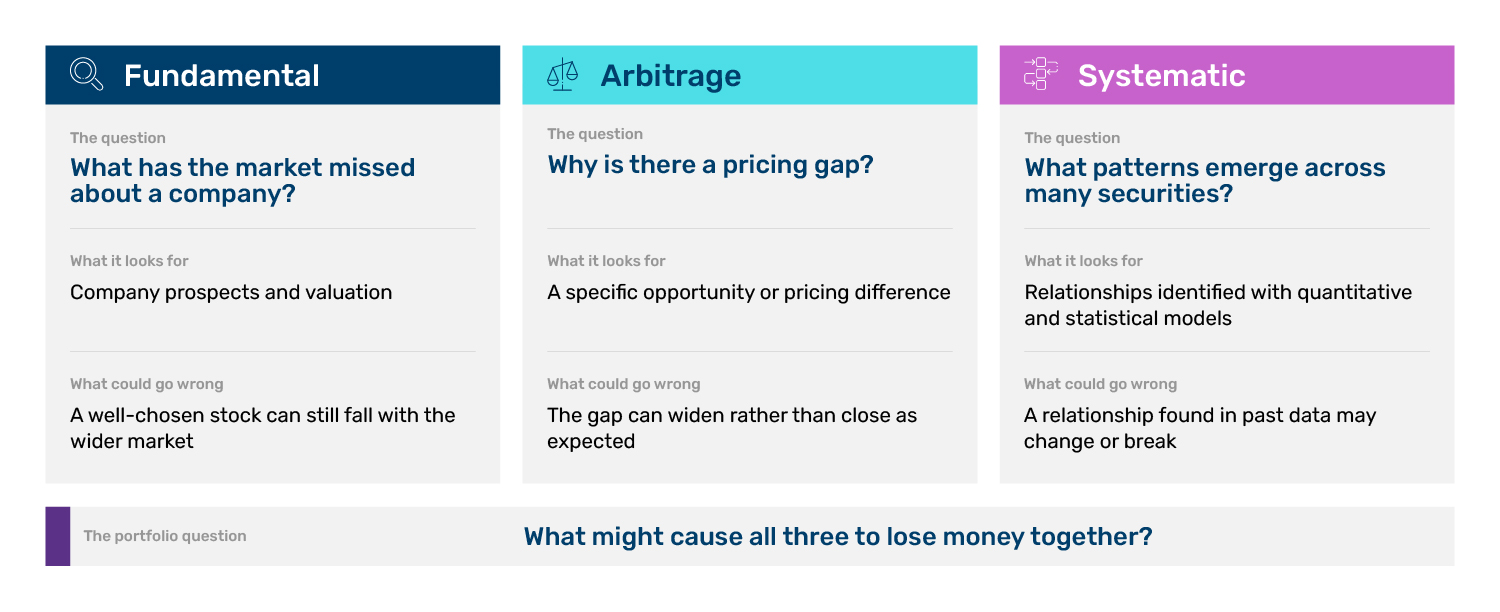
Consider three ways an investor might actively approach the same equity market (figure 1):
- Fundamental investing asks: what has the market missed about a company? An investor studies its business, finances, competitors and valuation, then forms a judgement about what the shares are worth. The opportunity lies in the gap between that assessment and the market price. Getting the company fundamentals right matters, but so does what happens in the wider market: a well-chosen stock can still fall if investors pull back from equities overall.
- Opportunistic arbitrage asks: where do prices not quite add up? A particular event or a difference in how related securities are priced could create an opportunity. Its return may depend less on the market’s overall direction as a result. Consider a take-out target in a merger bid. Just the rumor of an acquisition can often produce a spike in the stock price. But expected outcomes can quickly change, deals can fall apart, the price gap can widen before it closes, and trading can become harder precisely when a manager needs to act.
- Systematic investing asks: what can disciplined analysis detect across a large number of securities? Quantitative and statistical models apply defined rules to look for patterns or relationships. They have the potential to assess many opportunities consistently, without needing a fresh discretionary decision for every position. That discipline is useful but of course still not a guarantee. A relationship that held in past data can weaken or break when market conditions change.
Figure 1: Illustrative example of a potential multi-strategy equity approach
Source: Man Group. Illustrative schematic
Each of these approaches starts with a different question. That could be more meaningful than simply adding another list of stocks to a portfolio. But different approaches do not always deliver different outcomes.
Different strategies are not automatically diversified
Imagine a sharp disruption that makes trading more difficult and prompts a manager to reduce risk. Fundamental positions may fall with the market. An arbitrage opportunity may move further from the price a manager expected. A statistical relationship may stop behaving as its model anticipated. Different approaches can still lose money at the same time.
This is why the work of combining strategies matters as much as choosing them individually, in our view. It can be helpful to consider the intended contribution of each approach, what conditions could challenge this, and whether different approaches might suffer losses together.
In a multi-strategy approach, allocations consider estimates of how underlying strategies may perform under stress and the probability of synchronized losses. The intention is to build a portfolio around how strategies might behave together, not just whether their historical returns look different over an average period. Those estimates require judgement. Markets can produce shocks that no model or past observation has captured, and there is no guarantee that losses will not coincide.
What is each strategy and approach there to do?
A useful test for any equity multi-strategy allocation is: can you explain how each approach seeks a return, and what could potentially cause them all to lose money together?
Your answer should be clear to avoid simply holding a long list of strategies which offer little reassurance. Yet, even if it appears clear, you may still be blinkered about the allocation’s intended role, its limits and the risks it may pose. Fundamental approaches could be limited by how much research a manager can realistically perform. Execution risks could add up if a statistical arbitrage setup is not carefully calibrated. And Black Swan events that produce broad-based downturns typically have the potential to indiscriminately drag down entire stock markets, and systematic strategies with them.
Diversifying within equities is not a matter of collecting more strategies, in our view. We believe it starts with understanding what each one depends on, and what they might depend on together.
You are now leaving Man Group’s website
You are leaving Man Group’s website and entering a third-party website that is not controlled, maintained, or monitored by Man Group. Man Group is not responsible for the content or availability of the third-party website. By leaving Man Group’s website, you will be subject to the third-party website’s terms, policies and/or notices, including those related to privacy and security, as applicable.