Key takeaways:
- Global listed infrastructure has evolved into a distinct asset class built around the essential assets that keep economies running, from power grids and pipelines to airports, toll roads and digital networks
- The asset class combines characteristics that are difficult to find elsewhere, including inflation-linked revenues, visible cash flows and diversification from both equities and fixed income
- After a decade of underperformance relative to global equities, infrastructure may warrant a fresh look as investment in energy systems, digital infrastructure and supply chains accelerates
Every day, billions of people rely on infrastructure without giving it much thought. At least not until the lights go out, there’s no water, a toll road closes or the internet stops working. Behind these essential services sits a large and diverse universe of publicly listed companies that own and operate the assets on which modern economies depend.
Global listed infrastructure has grown from a niche institutional allocation into a distinct asset class with a market capitalisation of around US$8 trillion. Its role in economic development is difficult to overstate. Analysis by Boston Consulting Group of 92 countries over three decades found that a sustained 5% increase in infrastructure stock was associated with long-run gross domestic product growth of up to 0.45 percentage points, with the largest effects seen in energy infrastructure in developed markets.
The investment required to support future growth is unprecedented. Meeting rising demand for electricity, upgrading ageing power networks, expanding digital infrastructure and modernising transport systems is estimated to require more than US$150 trillion of cumulative infrastructure investment by 2050.
For investors, listed infrastructure offers a combination of features that can be difficult to replicate elsewhere in public markets, including low correlation to fixed income, lower beta than broader equity markets without sacrificing returns, structural inflation protection, real asset exposure and attractive dividend yields. At the same time, it provides access to several of the themes likely to shape the global economy for years to come, from the energy transition and energy security to artificial intelligence (AI), digital infrastructure and changing supply chains.
In this two-part paper, we examine the case for global listed infrastructure within a diversified multi-asset portfolio and explore why the asset class appears increasingly relevant in today's market environment.
Defining the asset class
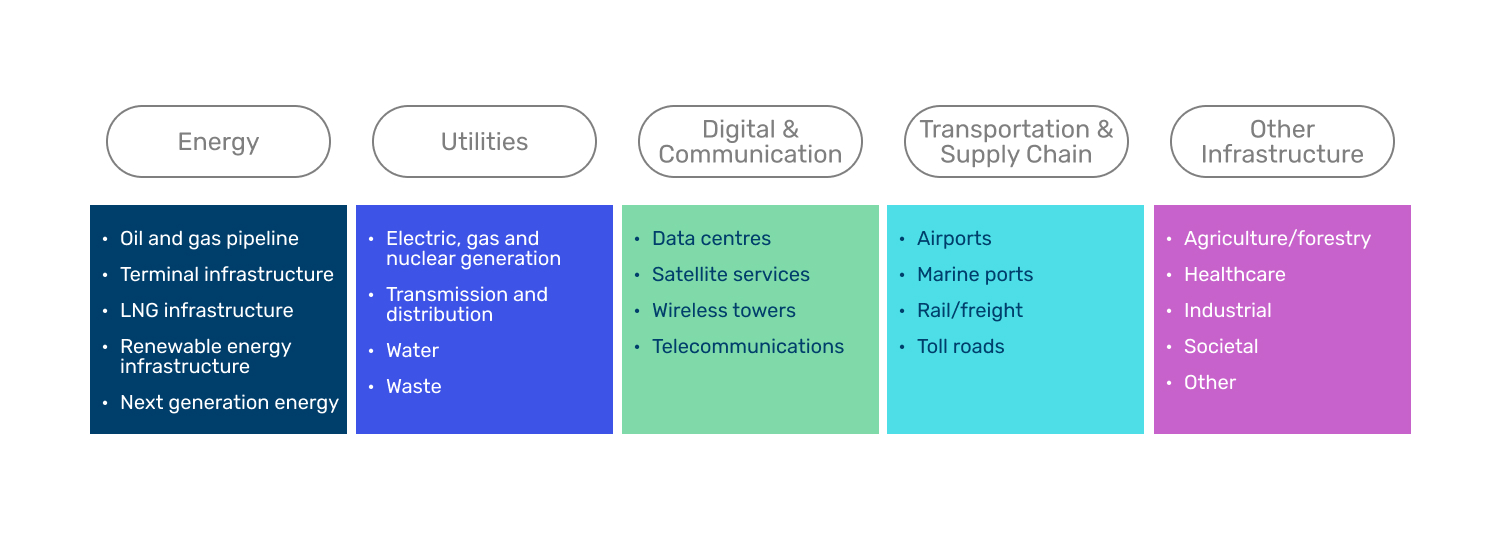
Global listed infrastructure includes publicly traded companies that own, operate or finance the essential assets on which economies and societies rely. The investable universe includes more than 700 companies with market capitalisations above US$1 billion. Yet infrastructure accounts for less than 5% of the MSCI World Index, meaning investors with a broad global equity allocation have only limited exposure to the sector.
Figure 1: The global listed infrastructure universe by sector
Source: Man Group.
Infrastructure companies tend to own long-lived physical assets that benefit from high barriers to entry, inelastic demand and revenues that are often contracted, regulated or linked to inflation. Many operate assets where competition is naturally limited, as there is little economic justification for duplicating existing infrastructure. That can help support resilient revenues. New entrants typically face planning restrictions, high upfront capital requirements and, in some cases, exclusivity agreements. The assets themselves often remain in service for 30 to 100 years.
Understanding the economics
1. Predictable, contractual cash flows
Infrastructure companies generate revenues that are often less sensitive to economic cycles than those of most other equities. Many assets operate under long-term contracts, concession agreements or regulated frameworks, which, together with their long asset lives, can provide a high degree of revenue visibility. As providers of essential services, infrastructure businesses have historically held up relatively well during periods of economic stress, reflecting the resilience of underlying demand. Revenue streams are also frequently linked to inflation through regulatory arrangements or contractual mechanisms, helping to support cash flow stability and making infrastructure one of the highest-yielding sectors in public markets.
Revenue models generally fall into one of three categories:
- Regulated returns. Utilities operate within frameworks set by regulators, which allow them to earn a return on their regulated asset base. This can provide earnings visibility, although allowed returns are periodically reset and companies may earn less than the permitted level
- Contracted revenues. Pipelines and renewable energy assets often operate under long-term take-or-pay contracts with creditworthy counterparties, sometimes extending for 20 to 30 years
- Concession and volume-based revenues. Airports and toll roads typically operate under government concession agreements, with usage linked to economic activity and population growth over time
The result is a cash flow profile that has tended to be both predictable and resilient, allowing companies to invest in their assets while continuing to pay and grow dividends over time. This blend of income stability and return growth gives infrastructure characteristics that are often associated with both equities and fixed income. The sector's relatively high level of dividend distribution has also made it a popular allocation for income-focused investors and those managing long-term liabilities. We estimate that the S&P Global Infrastructure Index, measured through the iShares Global Infrastructure ETF (IGF), has one of the highest dividend yields among the major market sectors, with a long-run average yield of around 3.5% and a five-year annualised dividend growth rate of more than 11%, roughly double that of the MSCI.
Figure 2: IGF dividend yield, 2008–2026
Source: Bloomberg, iShares Global Infrastructure ETF (IGF), quarterly data, as at 30 June 2026.
Problems loading this infographic? - Please click here
2. Inflation protection: A structural feature
Inflation linkage is a common feature of many infrastructure assets. Tariffs, tolls and regulated returns are often linked to the Consumer Price Index (CPI) or Producer Price Index (PPI), which can help revenues keep pace with rising prices. Many infrastructure businesses also provide essential services, meaning demand tends to remain relatively stable across economic cycles. That can contribute to lower earnings volatility than is typically seen in broader equity markets.
- Regulated utilities typically see their asset bases revalued in line with inflation, with allowed returns adjusted accordingly
- Toll roads in many jurisdictions have tariff frameworks that rise with CPI
- Pipeline contracts frequently incorporate inflation escalator
- Airport aeronautical charges are often linked to inflation measures
The combination of inflation-linked revenues and resilient demand can be particularly valuable when inflation rises faster than growth. During the 2021 to 2024 inflationary period, infrastructure revenues and dividends generally moved higher alongside price levels, while real asset values remained relatively resilient. Figure 3 illustrates this relationship. Infrastructure's advantage over global equities has historically been greatest during periods of low growth and high inflation. Broad equity markets have tended to perform better when growth and inflation are both strong, although such environments have occurred relatively infrequently.
Figure 3: Index performance by economic regime, 2000–2025
Source: Bloomberg, S&P Global Infrastructure Index, Invesco MSCI World UCITS Acc ETF, SXI Real Estate, Bloomberg Global Agg Treasuries Total Return Index , as at 31 December 2025.
Problems loading this infographic? - Please click here
3. Historical return profile
Global listed infrastructure has historically delivered competitive returns with lower beta than broad equity markets. It has also exhibited low correlation to fixed income over long periods, providing a potential source of diversification within a portfolio. A global allocation adds further diversification across regulatory regimes and economic cycles. Combined with a growing dividend base and favourable capture characteristics, these features have supported strong long-term returns. Since the S&P Global Infrastructure Total Return Index was launched in 2001, it has generated higher returns than the MSCI World Total Return Index, while exhibiting lower beta and asymmetric capture ratios.
- Higher Sharpe ratio. Between 2002 and 2025, we calculate a Sharpe ratio of 0.531 for global listed infrastructure, compared with 0.35 for global equities and 0.20 for global fixed income
- Downside mitigation. Infrastructure has typically demonstrated defensive characteristics during equity market drawdowns. Over long periods, we estimate a downside capture ratio of 75% relative to the MSCI World Index
- Lower beta. Infrastructure has typically exhibited a market beta of around 0.85 relative to broad equity markets, which has historically provided some cushioning during periods of market stress
4. Diversification from traditional asset classes
Listed infrastructure has historically exhibited low correlation to investment-grade bonds and lower beta than broad equity markets, while also delivering competitive returns and substantial cash distributions. Adding listed infrastructure to a traditional 60/40 portfolio has been shown empirically to improve the efficient frontier, either by reducing portfolio volatility for a given level of expected return or increasing the expected return for a given level of risk. A global portfolio also provides exposure to a diverse set of infrastructure assets, from utilities, pipelines and digital infrastructure in North America to airports and rail in Europe, toll roads in Australia, and airports and ports across Asia Pacific. This geographic breadth helps reduce country-specific regulatory and political risk while providing exposure to different stages of the infrastructure investment cycle.
Risks and considerations
Like all asset classes, global listed infrastructure carries a distinct and sometimes underappreciated set of risks that must be understood before they can be managed. The most immediate and widely cited is interest rate sensitivity. Infrastructure companies are, by their nature, capital-intensive businesses that rely heavily on debt to finance long-lived assets. Rising rates compress equity valuations through two simultaneous channels: they increase the cost of financing, squeezing returns on invested capital, and they erode the relative attractiveness of infrastructure dividend yields against a rising risk-free rate.
Beyond rates, the sector is acutely exposed to regulatory and political risk. Infrastructure companies operate under frameworks that governments design and can redesign. Allowed returns can be cut, windfall taxes imposed, permitting processes blocked or extended indefinitely, and tariff structures rewritten.
For merchant infrastructure – meaning assets without fully contracted revenue streams – investors must also bear direct exposure to volume and pricing risk. The earnings of assets like uncontracted pipelines, merchant power plants and airports can be materially volatile, shifting the risk profile closer to commodity markets than the regulated utility model.
Growth-stage infrastructure introduces a further layer of construction and execution risk. Cost overruns, supply chain disruptions, permitting delays and technology uncertainties can erode, or in extreme cases eliminate, the returns underwritten at the time of investment.
Perhaps the most structural and least fully priced risk is technology obsolescence. Fossil fuel infrastructure faces a potentially gradual but real risk of market share erosion as the energy mix shifts. The risk extends across the sector: distributed generation and behind-the-meter storage threaten traditional utility distribution economics; EV adoption degrades liquid fuel infrastructure volumes; and even digital infrastructure faces the risk of rapid technological change outpacing the long asset lives underwritten at construction.
Understanding these risks is the foundation of effective portfolio construction. Rigorous sector and stock selection that prices in regulatory exposure, contract structure, technology trajectory and balance sheet resilience can transform risk awareness from a constraint into a source of alpha. The infrastructure companies that compound value over the long run are precisely those whose risk profiles are most clearly understood, most carefully selected and most actively managed.
Conclusion
Global listed infrastructure sits in an unusual position today. Many of the characteristics that have historically attracted investors to the asset class, including inflation-linked revenues, resilient cash flows, diversification benefits and long-term growth drivers, remain intact. Yet after a decade in which technology-led equity markets have dominated returns, infrastructure has largely fallen out of favour.
That divergence matters. Historical returns suggest infrastructure has often rewarded investors over full market cycles, particularly in environments where inflation is elevated, growth is slowing or market leadership is broadening beyond a narrow group of companies. Whether those conditions persist is impossible to know. What is clear is that the asset class is entering the next cycle from a very different starting point than many areas of the equity market.
In the second part of this series, we examine several questions that follow from that observation, including the role of active management, the relationship between listed and private infrastructure, current valuations and the thematic forces shaping the sector's long-term outlook.
You are now leaving Man Group’s website
You are leaving Man Group’s website and entering a third-party website that is not controlled, maintained, or monitored by Man Group. Man Group is not responsible for the content or availability of the third-party website. By leaving Man Group’s website, you will be subject to the third-party website’s terms, policies and/or notices, including those related to privacy and security, as applicable.