Tomorrow is the 22 July, which, according to 20 years of market history, is supposed to be the most carefree day of the year for stock traders.
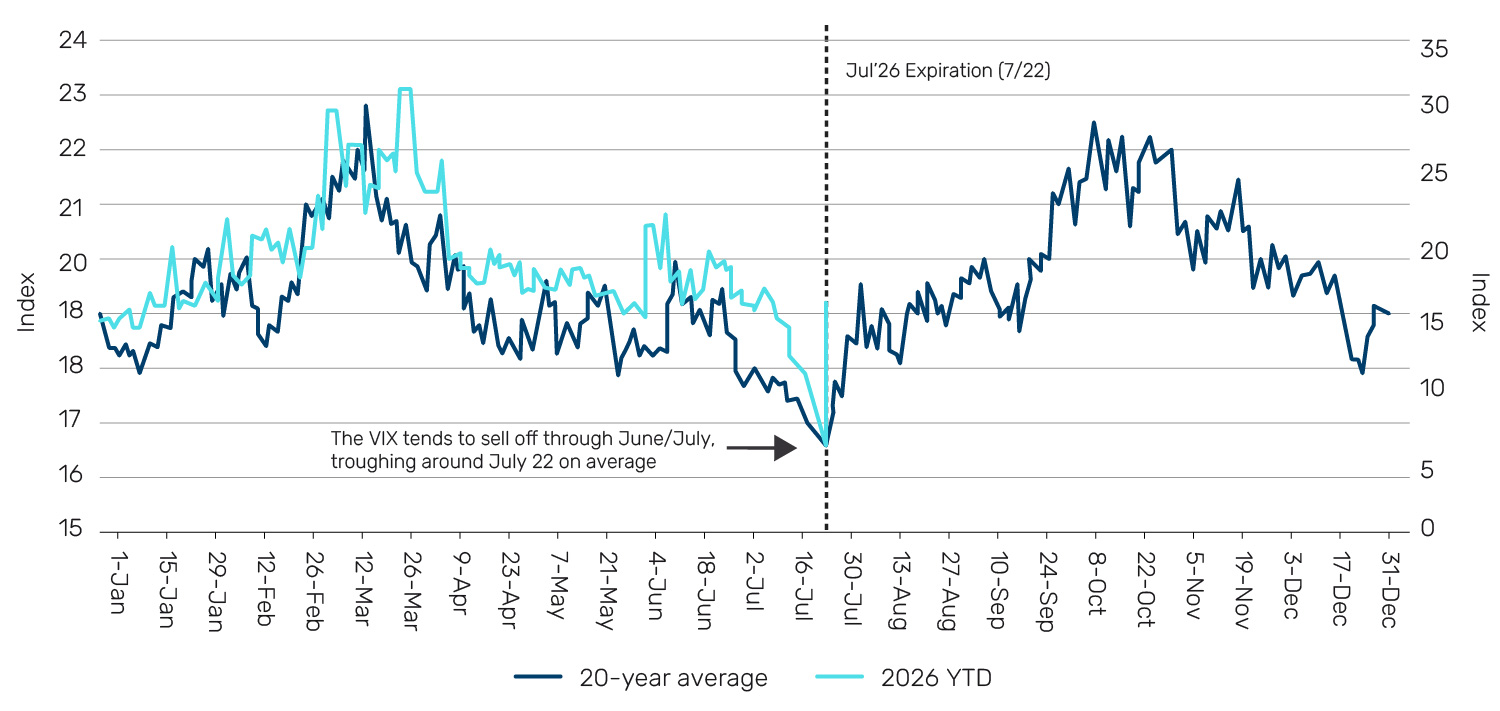
It’s the day the Cboe Volatility Index (VIX), also known as the market’s “fear gauge”, tends to bottom out for the year (see Figure 1). This year the market has followed that script almost to the letter, and that is either impressive composure or, as we suspect, a worrying degree of complacency.
Figure 1. The VIX is still in carefree mode
Source: Bloomberg, Susquehanna International Group, as at 20 July 2026.
We’ve had a run of AI mini-tantrums in recent weeks as well as the restart of the war in Iran pushing up the price of oil, yet the fear gauge has barely stirred. The VIX has sat between 16 and 19 for much of June and July and only shimmied to 19.5 during last Friday’s bear market, well short of the 30 or more that signals real panic.
Market participants appear happy to ignore some obvious and material risks, looking through to the promised land of large-cap tech and AI potentially saving us all. But there are cracks appearing in that singular, positive narrative, and it’s hard not to think we’ve been here before.
Dot-com deja-vu?
The AI buildout rhymes with the late-1990s rush to lay fiber and telecoms cable, when vast sums were borrowed to build infrastructure on the promise that demand would follow. Some of it did, but plenty of the debt went bad first, when the bills came due before the revenue. The mood, too, carries a whiff of the summer of 2007, serene and low on volatility until it wasn’t. Neither is a forecast, but both are worth remembering when the fear gauge is this quiet.
We are not only looking at the VIX; the whole dashboard tells a very similar story. Shares have stopped moving in lock step, with the tendency to rise and fall together down more than 60% this year, which is a sign that investors have stopped worrying about the big picture and are chasing individual winners and losers, chiefly AI and the data centres behind it. Corporate borrowing costs still sit near the bottom of their range, as if defaults were unthinkable. All of it holds while oil remains high, base interest rates have climbed, and the market continues to lean on the same few names.
So what happens next?
Nobody knows. Stripped of jargon, the VIX is just the market’s best guess at how far the S&P 500 could move, up or down, in the coming weeks, and right now it is guessing “not much”, just as the diary fills with potentially market-moving events like results from the world’s biggest tech firms and a Federal Reserve meeting, all before the end of July.
Much of this reads less as conviction than career maths. Own AI and be wrong, and you are wrong alongside everyone else. Sit it out and miss the rally, and you underperform alone, which reads as losing your nerve. Being early is the same as being wrong. So their safe move appears to be to keep holding the crowded names.
None of this says bolt for the exit. But when insurance is this cheap and the crowd this concentrated, it makes sense to have some exposure to a rise in volatility.
The chart above shows 2026 tracking the usual summer lull almost to the day, and if it holds, investors should start asking questions over the next few weeks. It is worth remembering that a big driver of this seasonality is defending or chasing performance, and this has been a strong year by almost any measure.
Labor Day in the US (on the first Monday in September) is traditionally the market’s second-half hydration break, and we expect investors to come back from it more defensive, keen to protect those gains regardless of the fundamental and macro backdrop. So the pattern holds, we think, for all the right and wrong reasons. Higher base rates and higher energy prices do feed through to higher cost structures. For now, though, the market keeps chasing the multiplicative upside of AI and large-cap tech on the assumption that ordinary corporate realities have no bearing. Those are the concerns of profitable companies.
Author: Matt Rowe, Managing Director, Solutions at Man Group.
You are now leaving Man Group’s website
You are leaving Man Group’s website and entering a third-party website that is not controlled, maintained, or monitored by Man Group. Man Group is not responsible for the content or availability of the third-party website. By leaving Man Group’s website, you will be subject to the third-party website’s terms, policies and/or notices, including those related to privacy and security, as applicable.